Posted in Writing Craft

Help! I Want to a Write a Historical Fiction Novel (But I Don’t Know Where to Start)

Note: This article fulfills the requirements of the “Research Blog Post” for ENGL 602 Methods and Materials Research, Liberty University, English PhD.

So, you want to write historical fiction. Congratulations! You have accomplished the first step when deciding to write a book—determining the genre of your novel. Most novel writing requires at least a little bit of research. What are the train schedules for a northbound train leaving London? What are the particular symptoms of an illness I want my character to have? How does one go about hiding a dead body….you get the picture. But historical fiction requires a great deal more research than the average book. Historical fiction is based on facts, usually real people, places or events, and although it is still fiction, your reader will want—and expect—the facts to be accurate. Nothing throws a reader off more than putting potatoes on the dinner plate of a 15th century lord in England, when potatoes didn’t arrive in Europe until the mid- 16th century. (The horror!)

As silly as that sounds, it is painfully true. Historical fiction readers expect authors to have done their research and not add things to their fiction that pulls the reader out of time and place when they are fully immerged in an intriguing historical tale. It is up to the writer to make sure they have done their research so as not to upset the flow of the story.

How Do I Know What I Need to Research?
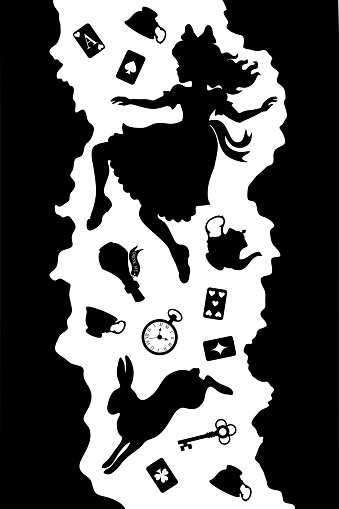
One of the easiest things to do when researching information for a story is to fall down the proverbial rabbit hole. Sometimes getting caught up in all the little historical details may not add to the overall plot and might feel like a waste of time. Yet, the information uncovered in these “rabbit holes” can add another layer of authenticity to the story and make the reader feel right at home in the setting that you are creating for them.

If you are not sure where to begin your research, start with the main points of the story. When did the events happen? Who are the characters involved? I also like to research the political climate. Who was the ruler during the period I am writing about? Was it a king or queen? A dictator? A president? The political and religious atmosphere at the time of your story can make a difference on how the story unfolds.

Once you have established the timeframe then you can move on to the smaller details. It might be wise to make a list of things that have changed over the centuries. Read over your story and ask yourself if the details you are giving are modern. When were they invented? How did the characters dress? Did they eat those kinds of foods? Did they use the vernacular that you are using in your storytelling? This could become quite an exhaustive list, but it can be narrowed down substantially by asking yourself what makes a good historical setting? The food? The clothing? The innovations? Or perhaps it is the facts surrounding the event that you are writing about or the place where the events occurred. Whatever stands out to you as making the most authentic story, focus on those things.

The political and religious atmosphere at the time of your story can make a difference on how the story unfolds.

If you are writing about real historical events or people, that adds another element of accuracy that leaves little room for error. Even though historical fiction readers must keep in mind that the story is fiction, they expect the events and characters to be accurately portrayed unless an author’s note at the end explains why they have deviated from the true story.

Where Do I Find the Information I Need?

Now that you’ve narrowed down what you need to research, you need to figure out where to find the information you need. Biographies and non-fiction history books are a great place to start. In fact, you may have already read a biography or other historical account which in turn inspired the story you now want to write. However, it is not always affordable to purchase all the books you need in order to get the information you seek. Also, libraries do not always have the books you need, especially if you live in rural areas where the town libraries are not well-stocked. Interlibrary loans, a service that allows patrons to borrow books from libraries outside of their local library are a possibility, if you have the time to wait for the materials to arrive. However, many books can be accessed online, either in eBook form or on publications sites such as Project Gutenberg. Depending on how old the book is, another great site is archive.org. This site has the published book, scanned and posted, and you can flip through the pages of the book as if you were actually turning the pages. There are great search options too, which makes it easier to look for specific information.

Academic sites such as JSTOR are also a great resource when researching historical information. They are especially useful if you are looking for primary sources in which you need information directly from the time period or event you are researching. However, these online libraries are usually not available to the general public without an affiliation with a university or other academic association. Some periodicals and other online journals such as The Historical Journal or History Today, also provide information. Sometimes there is a small fee charged, and some are free.

Another great resource is the historical blog. Historians, whether scholarly or armchair, provide useful information in the form of research that has already been done for you. Many blogs also post their bibliography or works cited, which can give you more information for your research. However, random blog sites can run the risk of inaccurate information if the blogger has not done careful research.

In her article, “Autobiography of an Archivist,” Nan Johnson speaks of finding material of use where she least expected it, such as old textbooks, speeches, essays, even annotations in college catalogues. Information on your topic can be found in a myriad of different places, you only need to start looking for it. Travelling to the places you are writing about (if possible), trips to the museum or even speaking with reenactment actors, can all be a means of gathering information about your historical characters and events.

How Do I Know if a Source is Credible and Appropriate for My Project?

As a general rule, historical information in the form of biographies and other non-fiction books can be counted on for the accuracy of information. These books contain bibliographies and utilize footnotes and endnotes to give the reader an idea of where the information came from.

However, as with other fields of study, at times historians can be one-sided in their telling of history. Unfortunately, sometimes the old cliché still rings true: history is written by the victors. Cultural, racial, and gender biases can occur and the information might be shared through the lens of a bygone era in which we cannot relate. These texts must be read with an understanding of the author’s viewpoint and how that viewpoint affects the information being shared.
When gleaning information from blogs and other informational sites online, careful consideration must be given to the truthfulness of information. When possible, check the author’s sources to verify accuracy by looking for the use of bibliographies and other links to see where the author obtained their information.

You also want to make sure the site is an appropriate source for the information you are taking from it. The information being provided from the chosen site should be well-researched and provided, to a certain extent, without bias.

Other valuable resources for historical information are documentaries and historical dramas. However, researchers must keep in mind that a lot of creative license is taken when filming historical pieces. It might be good for inspiration, but dramas should not be relied upon for historical accuracy. Documentaries would be a more appropriate choice if the information is coming from a reliable historian or other dependable researcher. However, documentaries are also not appropriate sources when researching clothing styles of particular eras, as the purpose of the documentary is usually to inform on events and people and not necessarily the clothing of the period.

How Do I Incorporate Sources into My Writing?

When writing historical fiction, it is generally not required to give references or cite sources, as the story is in fact fictional. Most fictional works print disclaimers at the beginning of the book, indicating that any information written in the story pertaining to real people is fictional and should be treated as such. However, many authors like to include historical notes in the back of the book, elaborating on the facts they used to create their story. If a certain historian’s viewpoint or information was used to perpetuate a certain idea concerning the characters or events, this would be the appropriate place to reference those sources. In her article, Creating Cromwell, Anne-Marie Harvatt explains, “How much attention the authors of historical novels give to theory varies, but their interviews, paratextual material, and metafictional commentary (self-referential and self-conscious commentaries within the text) suggest an awareness of the subjectivity of both their sources and novels, alongside a feeling of responsibility to the facts and a desire to justify their treatment of those facts.”  Incorporating historical facts into the fictional story is what historical fiction is all about, and a good writer can create an accurate story with only a partial truth.
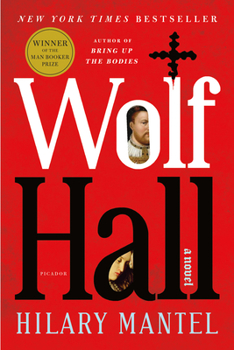
Harvatt takes a closer look at Hilary Mantel’s Wolf Hall to examine how historical fiction can influence the way we look at and learn about history.

Where Can I Find More Information?

Nan Johnson’s article, Autobiography of an Archivist, explains the many different ways she gathered information for her book, Nineteenth Century Rhetoric in North America. It is an excellent source for learning to view the media that we come in contact with every day, and how to look at the information surrounding us in order to use it for writing purposes. Her article can be accessed here.

Anne-Marie Harvatt’s article, “Creating Cromwell: An Aanalysis of the Historical Novel’s Position and Potentiality Through a Study of Hilary Mantel’s Wolf Hall Trilogy,” is an excellent source that discusses the role historical fiction plays in interpreting history and conveying historiography. It can be accessed here.

Works Cited:

Harvatt, Anne-Marie. “Creating Cromwell: an analysis of the historical novel’s position and potentiality through a study of Hilary

Mantel’s Wolf Hall trilogy”. Rethinking History, vol 28, no. 1, 5 Dec. 2023, pp. 70–87.

https://doi.org/10.1080/13642529.2023.2274773

Johnson, Nan. “Autobiography of an Archivist.” Working in the Archives : Practical Research Methods for Rhetoric and Composition,

Southern Illinois University Press, 2009, pp. 290–299, https://ebookcentral.proquest.com/lib/liberty/reader.action?

docID=1354654&ppg=305.

Posted in Guest Post, Writing Craft

Historic Worldbuilding in Fiction: The Use of Light

Join me as author Heather E.F. Carter talks about the use of light in historical fiction writing.

Hi. My name is Heather E. F. Carter, and I write eighteenth-century historical fiction. I have published one novel, The Black Unicorn, and I am currently at work on its sequel, which will have something to do with phoenixes in its title. In my own blog, I approach my historical topics through the lens of historic worldbuilding in fiction. In this blog, which I was happy to write for my friend and colleague Tonya Ulynn Brown, I shall be discussing the use of light, both natural and artificial, in the past. The eighteenth century is my area of expertise, but I do happen to know a few things stretching both before and after the long eighteenth century.

Light is a subject near and dear to my heart, and important to take into consideration when writing fiction set in the past.

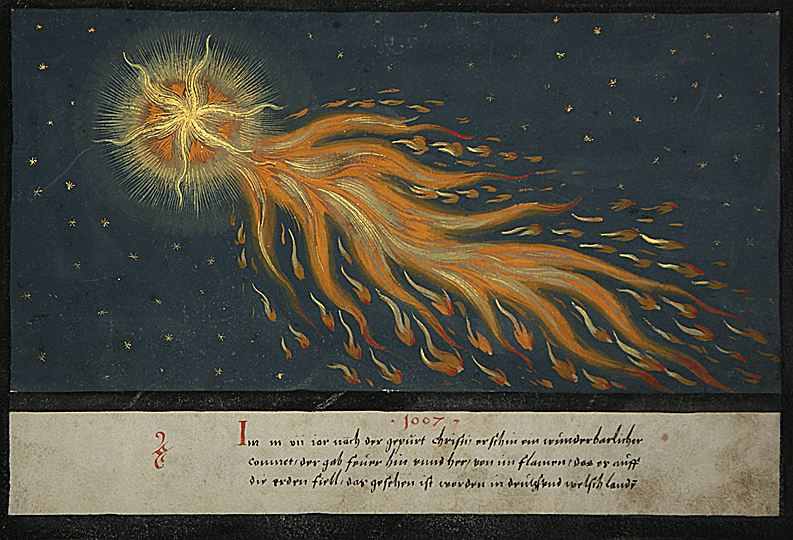
The fact is that people in the past simply saw the world differently than we do because of light. Even daylight was different, without all the pollutants in the air, and the night sky shone so brilliantly with stars that we must now go to very remote places on our planet to catch even a glimpse of what the ancients saw. And see things, they did: comets and shooting stars. Medieval writings abound with mentions of the things they saw in the night sky, usually interpreted as portents for evil things to come. Comets carried with them particularly evil omens. Comets foretold the Black Death, as well as just about any major war you can think of. Untimely death of a monarch or heir to an ancient family? Comet. Pestilence? Comet. Famine? Comet. You name it, there was probably a comet spotted in the sky by a diligent monk beforehand.

“Medieval writings abound with mentions of the things they saw in the night sky…”

And nightfall remained more absolute for centuries—even in the upper classes, who could afford artificial light in the form of candles and oil lamps and (Victorians) gas lighting, the quality of the light in no way approached what we enjoy today. And moonlight was more important; when the moon waned, people up to no good such as thieves and smugglers were out and about. Conversely, ladies planned social events on nights when the moon was full. If you have a ball or a soirée in your book, set it on nights when moonlight is strongest. And remember that the roads would have been crowded—during a full moon, people were out and about. And also bear in mind that there was safety in numbers. A footman in every coach would have been armed with a blunderbuss or other firearm, but honestly what made people safe was all the traffic clogging the roads.

 And when the moonlight wasn’t strongest, give your character brave (or crazy) enough to walk the city streets on foot a torch boy (a person—often a child—with a lantern, who hired out their light to those who could afford it) to light the way. However, bear in mind these torch boys often worked in concert with thieves and cutthroats, so there’s that complication to take into consideration.

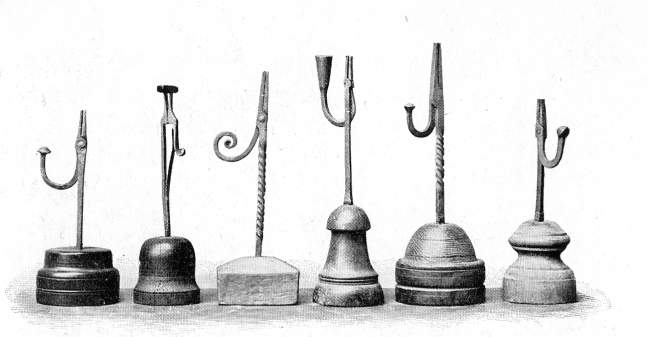
Needless to say, artificial light was hugely different, but people of the past came up with ways of dealing with it. Candle making was a household operation that goes back into distant time. In the Middle Ages and sixteenth and seventeenth centuries, villagers in the Fall and milder evenings of Winter would gather together around a common, outdoor fire: women would sew, men would gossip, lovers would flirt, and children would play. And in households wealthy enough to burn candles every night, there were a few different types: tallow (made from animal fat, and smelling like animal fat—these were also notoriously smokey) beeswax and spermaceti (often pulled out only for special occasions, even among the aristocracy) and the ubiquitous rush light. Rush lights could be made at home, and they carried with them the added benefit of not being taxed. In grand households, rushlights were the lights to be found in servants’ quarters. They were basically  the dried pith of a rush (the rush center) dipped repeatedly in fat. They were long and skinny, secured in a special stand, and their use spanned centuries. William Cobbett, in his nineteenth-century Cottage Economy, writes:

My grandmother, who lived to be pretty nearly ninety, never, I believe, burnt a candle in her life. I know that I never saw one there, and she, in a great measure, brought me up. . . . The rushes are carried about by hand; but to sit by, to work by or to go to bed by, they are fixed in stands made for that purpose. . . . These have an iron part something like a pair of pliers to hold the rush, which is shifted forward as it burns. These rushes give a better light than a common dip candle and they cost next to nothing. If reading be your taste you may read. . . as well by a rushlight as you can by the light of taxed candles. Qtd. In Artificial Sunshine: A Social History of Domestic Lighting, The National Trust, 39.

18th century rushlights

Brass reflectors and glass magnifiers were often used to enhance these lights. Do you have a character sitting in a darkened study reading documents after nightfall? I do, in my current work in progress. In fact, I have two such characters, sitting in studies on opposite ends of London. And they are both using a glass magnifier to intensify the candle light that they are reading by.

Now, the most common way to light a candle or rush light was to use an existing flame. Yes, there were tinder boxes, but there was a knack to using them successfully that many people simply didn’t have. James Boswell (b. 1740), whose primary fame lies in the fact that he is the prolific biographer of Samuel Johnson (poet, essayist, dramatist, and pioneering lexicographer), details the hassle he went through (and panic) when his light went out while he was in the midst of a creative endeavor.

“About two o’clock in the morning I inadvertently snuffed out my candle, and as my fire was long before black and cold, I was in a great dilemma how to proceed. Downstairs did I softly and silently step into the kitchen. But, alas, there was as little fire there as upon the icy mountains of Greenland. With a tinder box is a light struck every morning to kindle the fire, which is put out at night. But this tinder box I could not see, nor knew where to find. I was now filled with gloomy ideas of the terrors of the night. . . . I went up to my room, sat quietly until I heard the watchman calling ‘past three o’clock’. I then called to him to knock at the door of the house where I lodged. He did so, and I opened to him and got my candle re-lumed without danger.”

Qtd. In Jane Brox, Brilliant: The Evolution of Artificial Light, Boston, Mariner Books, 16.

So, if you’re having your characters use a tinder box, give some thought as to how easily they’d be able first of all to locate the tinder box, and secondly how easily they’d be able to achieve results. Aristocratic ladies, for example, likely would not have the skill set to use one properly. There was such a thing as a pistol tinderbox, also called a tinderbox pistol, which was a sort of mechanized tinder box—I use one in my writing. That’s an option too. In the following excerpt from my novel, The Black Unicorn, I have my main character Elina use one to achieve a light:

But, as my eyes adjusted to the darkness, I noticed a clever little pistol tinder box sitting on a table just inside the doorway, with an attached candle-socket and a brass barrel full of matches. Checking the receptacle for tinder, I cocked the pistol, shut down the striker, and pulled the trigger. On my first attempt, I found the telltale little spot of glow in the tinder, and pulled a brimstone match from the barrel to transfer the flame to the candle. Moments later, my candle held high, I stepped over the threshold into the dark, cool hush of a little world kept secret for almost two-hundred years.”

Heather E. F. Carter, The Black Unicorn,  68-69.

And once light was achieved, the quality of indoor lighting was basically poor. Even in aristocratic households, they were sparing of candles since not only were they a finite commodity, they were also taxed. Naturally, there was no Amazon to order more when one ran out. Sure, if you lived in London, you could send a servant down to the wax chandlers to buy more, but they were expensive—and even aristocratic households watched expenditure. However, no expense was spared in conspicuous consumption for the benefit of friends and neighbors. In ballrooms, it would be hot as hell from all those lit beeswax candles. And wax would rain down upon the revelers from the chandeliers, singeing bared shoulders and mucking up fine laced dress coats and piled-up hair pieces and powdered wigs.

Also, bear in mind that once the sun went down, the house was dark—much darker than anything we know. Street light, if your characters lived in urban areas, was often generally just a lantern lit in the doorway of every third to sixth house or so, depending upon the city or town ordinance. Nicer neighborhoods naturally had more light than poorer neighborhoods. So, if your character is going off on their own in search of a water closet or retiring early to their room, they’re going to need a chamber stick to light the way. And also, they are going to have to be damn careful! People died in the dark, taking a misstep here and tumbling down the stairs, or opening the wrong door there and falling into the cellar. Don’t believe me? In June 1776, an “’unfortunate man” staying at a tavern in New Haven “was going to bed without a light. . . [and] opened the cellar door instead of a chamber door, and falling down the cellar steps fractured his Scull, of which he expired the next morning.’” Jane Nylander, qtd in Brox, Brilliant, 17.

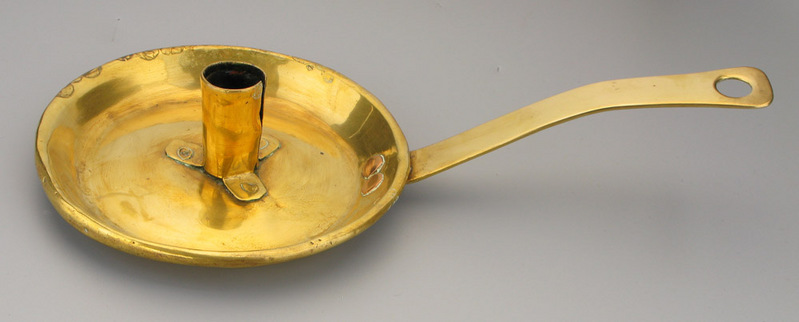
This 18th century brass chamberstick might have helped the “unfortuanate man” at the tavern in New Haven from falling to his death.

Finally, have fun with light. Because artificial light was imperfect, it’s a great place to write in some atmosphere—shadows were everywhere, and they moved. Think of how the shadows slide across your characters’ faces, the shape of the shadows on the wall, and how those shadows moved with the flickering and sputtering of the living flame. Also think of the color of the light—it wouldn’t have been white, like the light we enjoy today. Reflected off brass fixtures, gilt mirrors and furniture, and bejeweled buttons on clothing (at least for the aristos) it would have had a burnished, glittering or orange color to it.

The world of light in the past is, quite honestly, an alien country. It is something we simply cannot completely understand. The terrors of the night were real. Darkness was a yawning leviathan. But it was also an unbelievably magical monster, as well as a devilishly sensual one. It heightened senses that do not get much exercise in modern times. Close your eyes, and imagine for yourself this strange world of light and darkness, and have fun with it. It is like a whole another character!

About the author:

Heather E. F. Carter writes historical fiction, historical romance, and erotic short stories. Though a lifetime Southern Californian, the settings of her novels are not foreign to her, having spent time each year in her parents’ hometown in Northern England. An accomplished academic, she combines her areas of expertise with her passion as she weaves historically authentic and timelessly relevant tales of love and intrigue. Having earned a B.A. in European history from UCLA, an M.A. in Medieval Women’s History from CSUF, and an M.A. in Early Modern History from UCLA, she left her studies midway through a doctorate in eighteenth-century English history when she discovered her passion and propensity for writing novels. While on a year’s leave of absence in her sixth year at UCLA, she put her doctoral research to good use writing THE BLACK UNICORN, a historical romance set in eighteenth-century North Yorkshire. Fascinated with Baroness Orczy” Scarlet Pimpernel stories, she was inspired to explore her first love, Sir Percy Blakeney, and wondered what he might have looked like if he were a little less heroic. That idea, combined with her love for vampire stories and the classic Gothic hero, led to the creation of Ashby Harcourt, also known as the highwayman behind the sobriquet The Back Unicorn. Her family’s history on the gothic North Yorkshire Moors, which grew in her annual visits with her beloved grandmother, was a natural choice for the setting. Heather’s passion for the research and writing of THE BLACK UNICORN comes alive on the pages through the vivid scenes and seductive dialogue. As you surely will, she fell in love with her story, so much so that she eventually chose to leave academia to pursue writing fiction full time. When she is not setting the pages on fire with her steamy romance, she is spending time at home in Sand Diego with her musician husband, Terry Carter, their adorable and precocious twins, and pet snake, Zanzibar. Music runs in the family, and Heather also plays the flute and supports her husband’s burgeoning ukulele empire. Currently she is researching Revolutionary Paris for the sequel to THE BLACK UNICORN.

Follow Heather on social media:

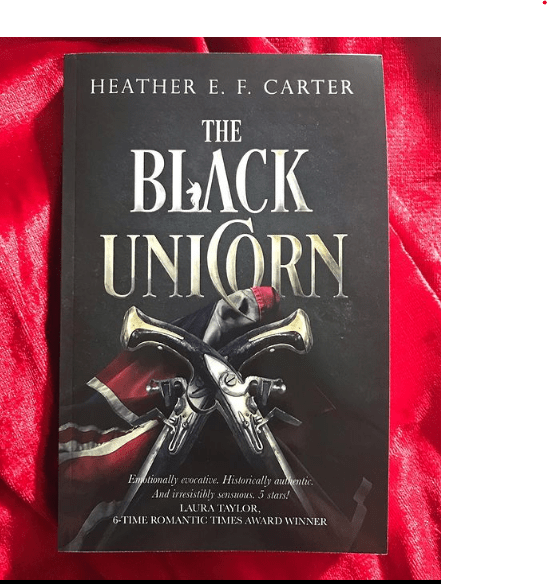
Check out Heather’s debut novel, The Black Unicorn.

Photo credits in the order they appear:

1. manuscript comet: http://jessehurlbut.net/wp/mssart/?tag=comet

2. comet: https://publicdomainreview.org/collection/flowers-of-the-sky

3. book photo, The Black Unicorn: Tonya Brown

4. rushlights: http://colonialsense.com/Antiques/Other_Antiques/Early_Lighting/Rushlights.php

5. chamberstick: http://www.chambersticks.com/21/#jp-carousel-3569

6. author photo: Heather E. F. Carter