Posted in Books

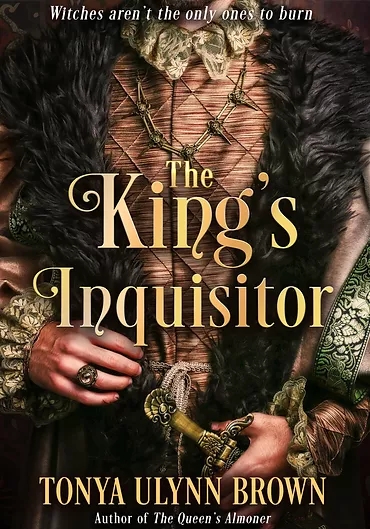
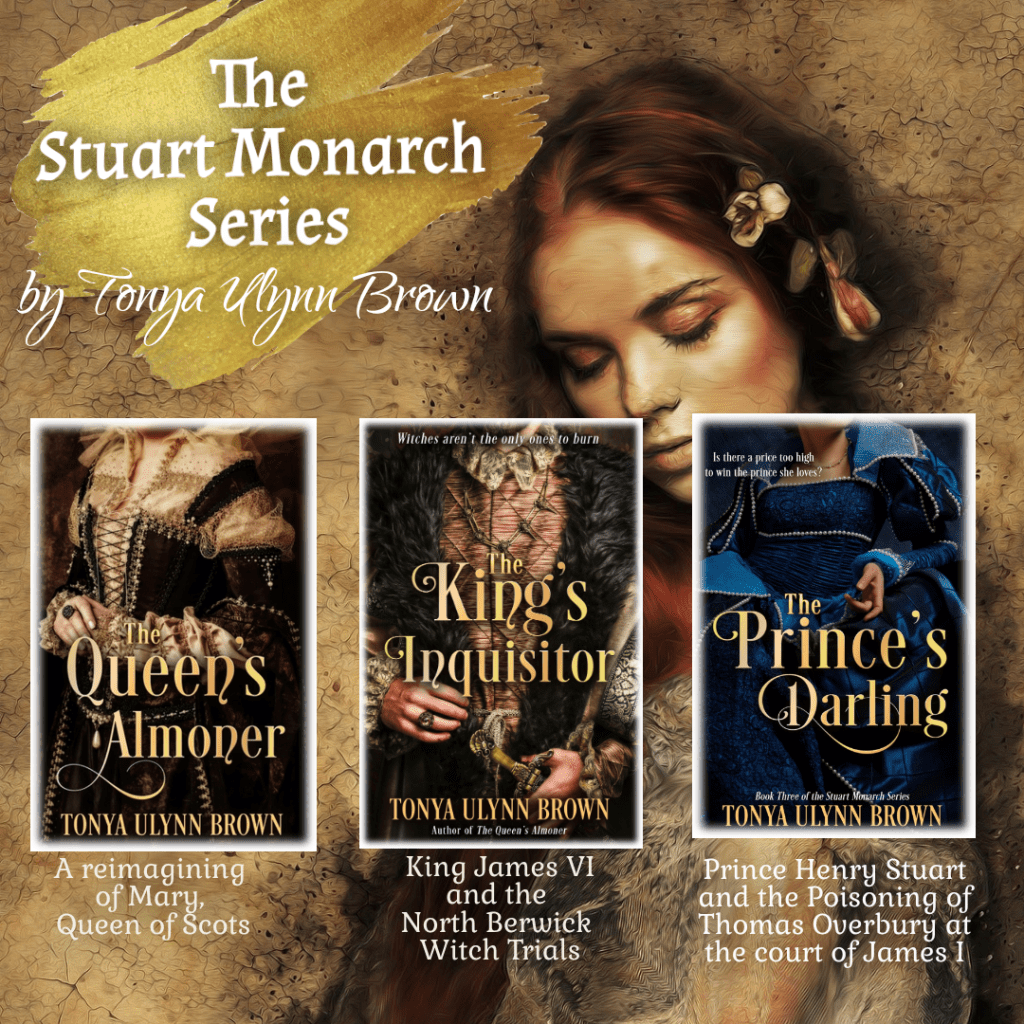
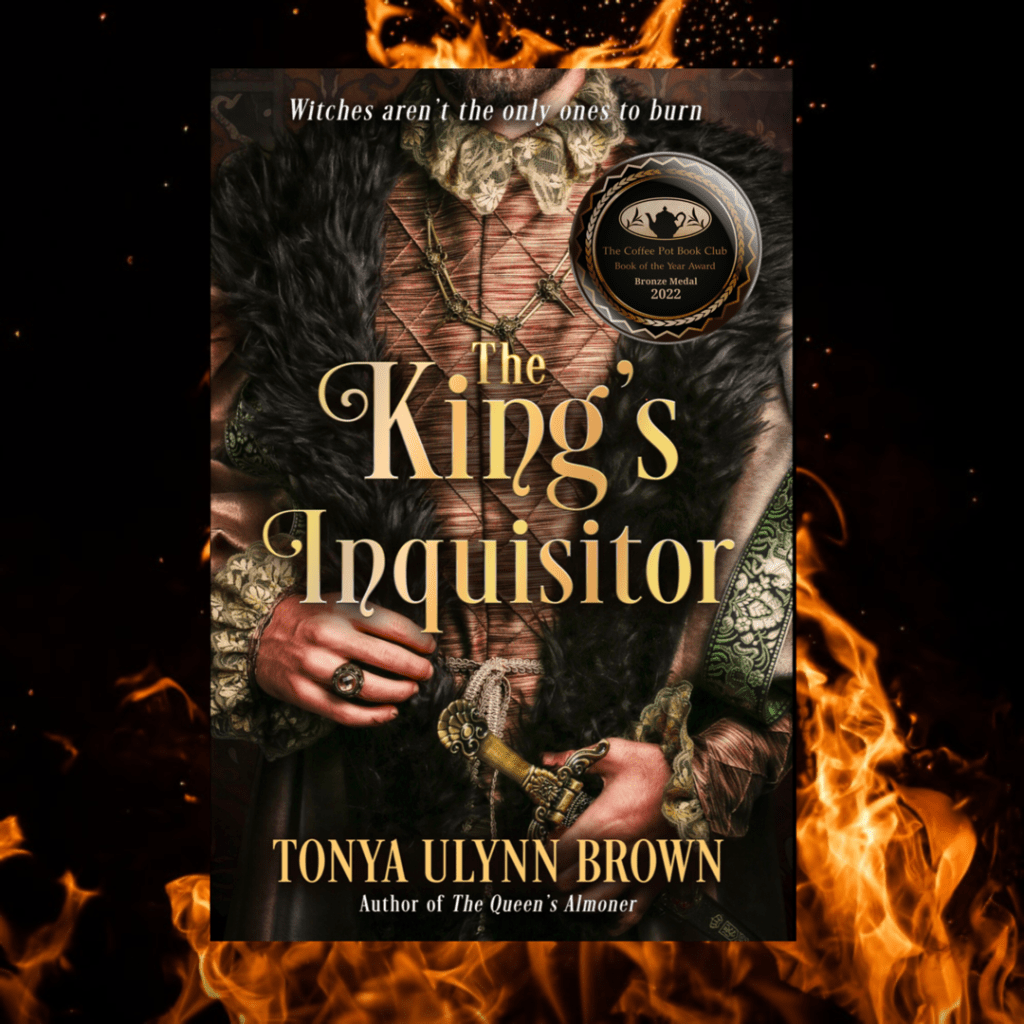
The King’s Inquisitor Cover Reveal & Release Date!

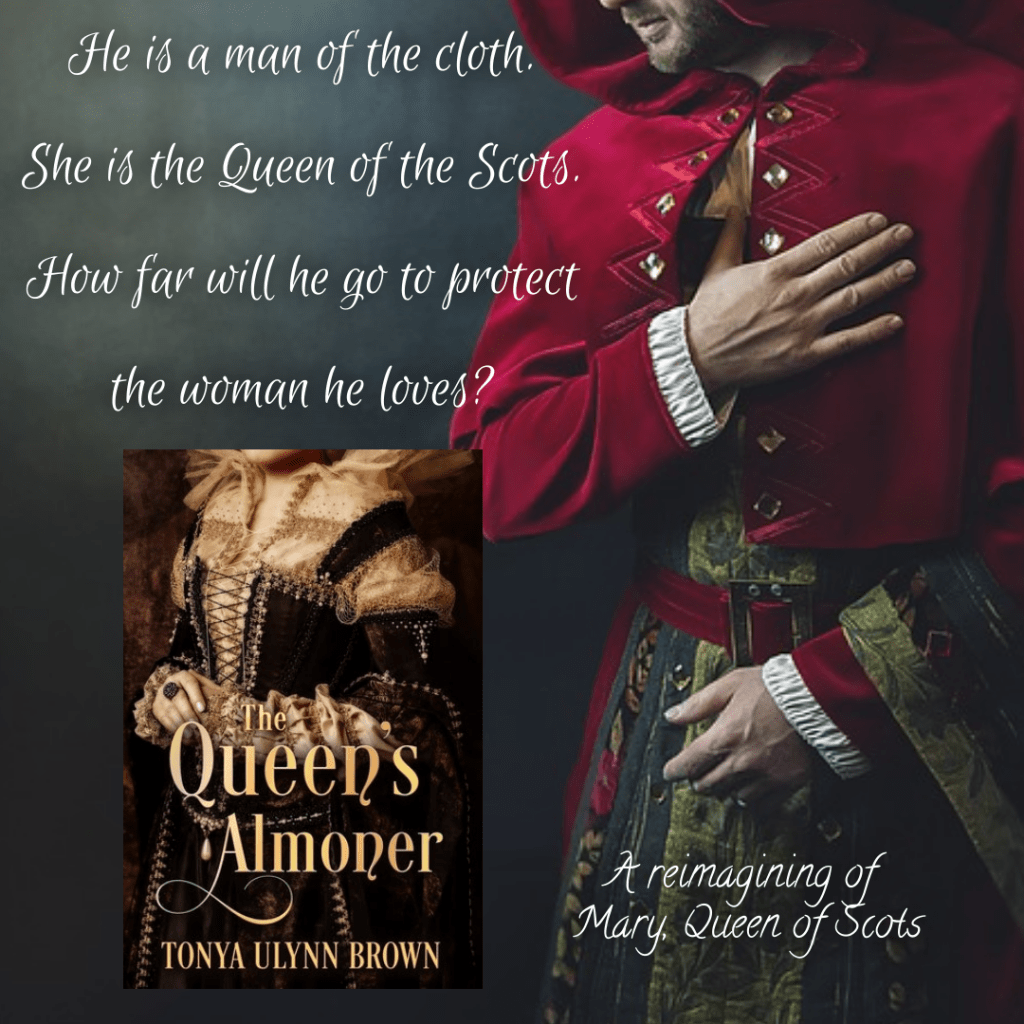
Just a quick post to share with you the cover of my upcoming second novel, The King’s Inqusitior. Release date has been set for July 1st, and you can preorder now and get a 10% discount if you order from Late November Literary! Use code: Discount_10

Here is a quick blurb:

Witches aren’t the only ones to burn.

The queen of Scotland is dead and the almoner’s son, William, has fulfilled his father’s wish that he should serve the king, James VI, at court. But when William finds himself caught between loyalty to his long-time friend and sovereign, and following his own conscience, he finds the choice too difficult to make. As William is forced to serve as the king’s inquisitor in the North Berwick witch trials, he must make a decision. Will he do what the king asks, and earn the wife, title and prestige he has always longed for, or will he let a bold Scottish lass with suspicion hanging over her head, influence him to follow his heart and do the right thing?

​If William doesn’t make the right choice, he may be among the accused. 

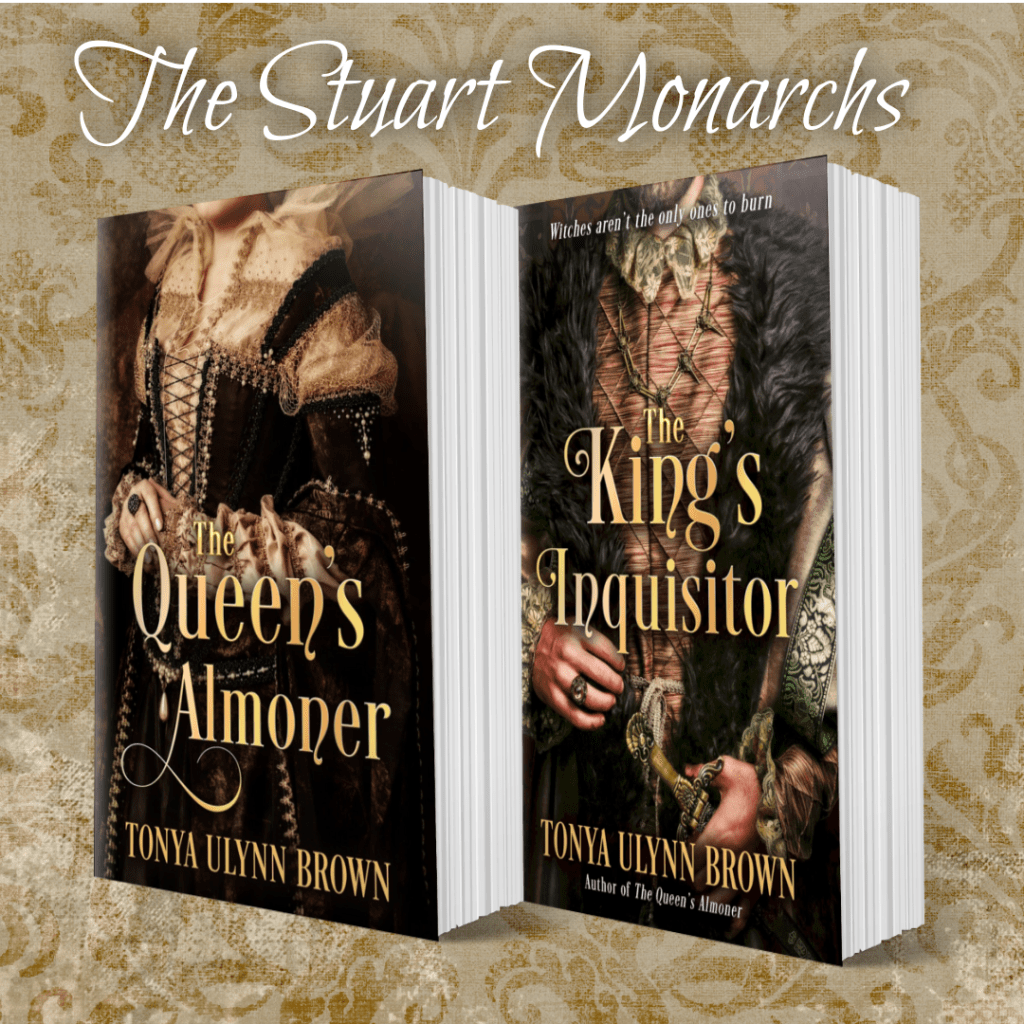
This is the second book in the Stuart Monarch Series. Both books are standalones. You do not have to read The Queen’s Almoner to understand The King’s Inquisitor. However, you are sure to recognize some of the characters from the first book.

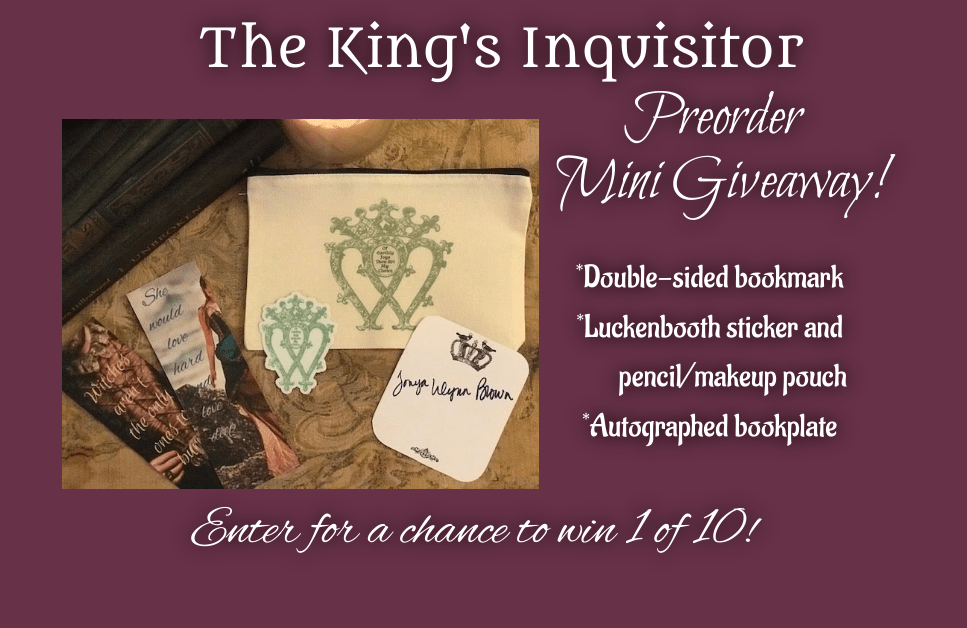
In addition to getting a 10% discount, if you preorder before July 1, you can also be entered into my Instagram Preorder Mini Giveaway! It’s easy:

  1. Follow me on Instagram.
  2. Order your copy of The King’s Inquisitor by June 30, 2022.
  3. Take a snapshot of the order confirmation email.
  4. Direct message me the pic on Instagram. It’s THAT simple!

You could win 1 of 10 prizes!

Posted in Guest Post

Historical Artistry: The Story Behind the Mary, Queen of Scots Paper Doll Coloring Page

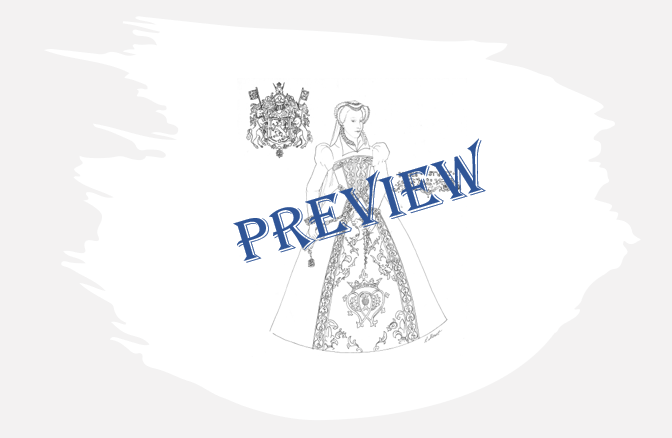
​​I have had the pleasure of working with Rebecca on several art commissions. She is amazing! My first experience with her was when I commissioned her to create a coloring page to accompany my first novel, The Queen’s Almoner. This download is a free gift for my newsletter subscribers on my author website. You can download your free copy by signing up at http://www.tonyaubrown.com.

Rebecca is not just another artist (is there even such a thing?!). But she is a lifelong student of historical characters and events, and she puts a lot of research and thought into the art that she creates. Rebecca is currently working with another wonderful artist, Ashley Risk, on a second commission for me that will be used alongside my next historical novel coming out later this summer, The King’s Inquisitor. You can read more about that book here.

​Take a look below as Rebecca explains how she came about the design for the Mary, Queen of Scots coloring page.

Dear Reader,

I thoroughly enjoyed creating this image of Mary, Queen of Scots for the author of The Queen’s Almoner, Tonya Ulynn Brown.  She and I share a passion for two queens who happened to grow up at the glittering French court, only to return to a devastating fate on their native shores of the British Isles.  However, their deaths should not define them. 

What gives women from the past agency is to recognize fully their achievements more so than their treatment at the hands of ruthless individuals. As Dr. Owen Emmerson, Historian and assistant curator at Hever Castle has said, with Anne Boleyn, “We tend to see her backwards” and so create a narrative which predetermines her fate. The same is true of Mary, Queen of Scots. Consequently, it is important to take a holistic view of the lives of both of these women—of all women in history, really—as well as women in our present. 

The irony is not lost on me that Mary, Queen of Scots died at the hands of the daughter of Anne Boleyn. Yet, I feel very strongly (and not to be too reductionist here) that Elizabeth I’s decision was based on fear mongering and Mary’s use by Catholic nobles more so than the feelings these women had for each other. This is evidenced when Mary was first taken captive by her Scottish nobles.  Elizabeth I was horrified at Mary’s treatment as a queen regnant and demanded her release (Porter). 

However, I’m not here to argue over four hundred-some-years of history; but I do wish to show, through my drawing, that Mary, Queen of Scots stands tall in history. As a result, I wanted to incorporate into this image, symbols which show her strength, her character, and her agency. 

Firstly, the shield in the upper left hand corner can be well explained by J. Paul Murdock from his blog “A Royal Heraldry:”

When Francis died at the end of 1560 and Mary became a widow and Dowager Queen of France, her Arms changed slightly, and France became dimidiated and not impaled. France’s half of the Shield showed only half of France’s Coat of Arms. The fashion of either impaling Arms (where the full Arms are used on both sides) and dimidiation (where half the Arms are used and both ‘merge’ into one another) is an often confusing topic in itself.

The representations of Mary’s Arms shown here are taken from Mary’s seals and Scottish coins of the time. No coins were issued in Scotland however, between 1562 and 1565. Thereafter, only the plain Scottish Arms were used again as can be seen in (the drawing). 

The use of unicorns is intriguing and has been explained in the following way:

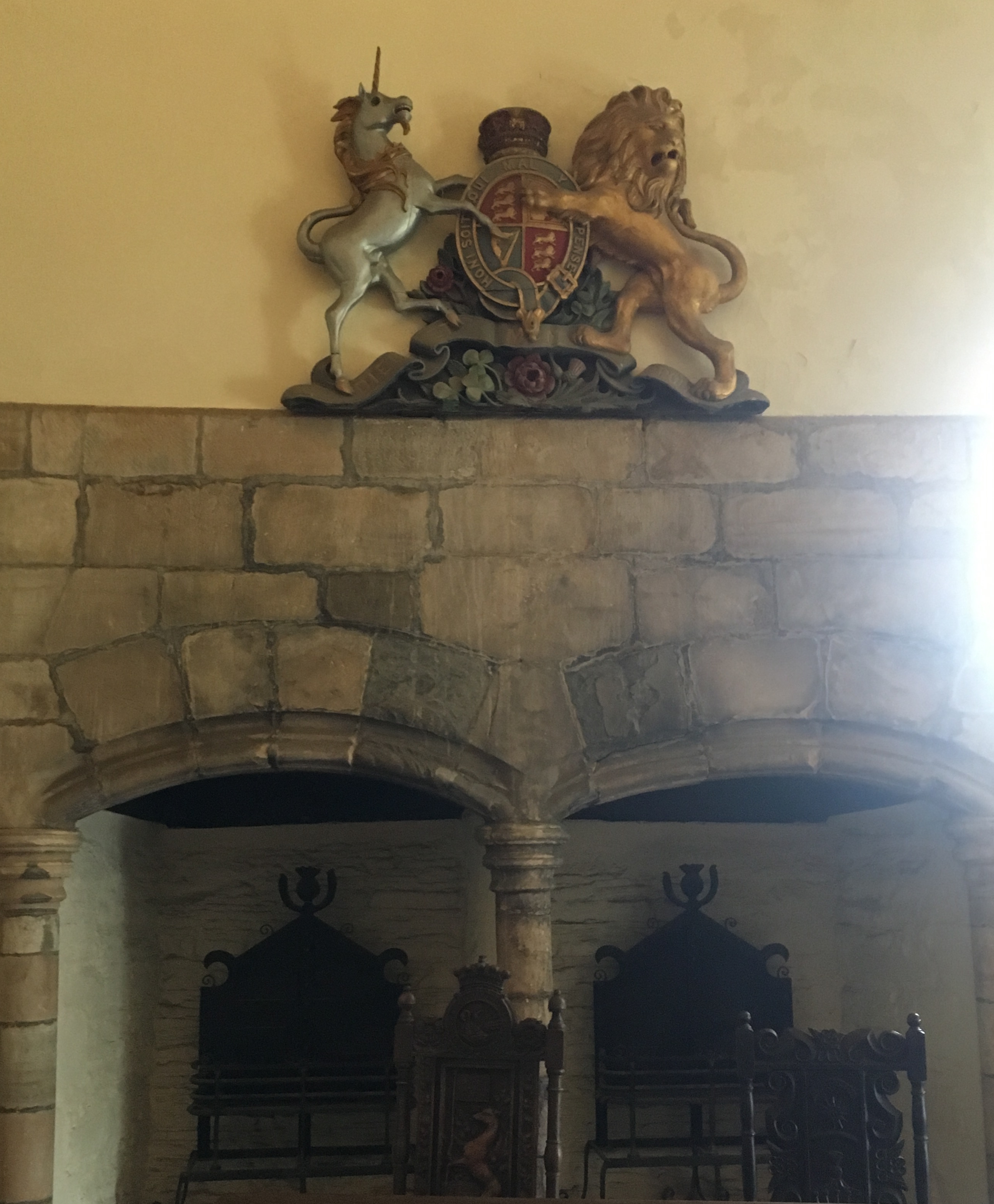
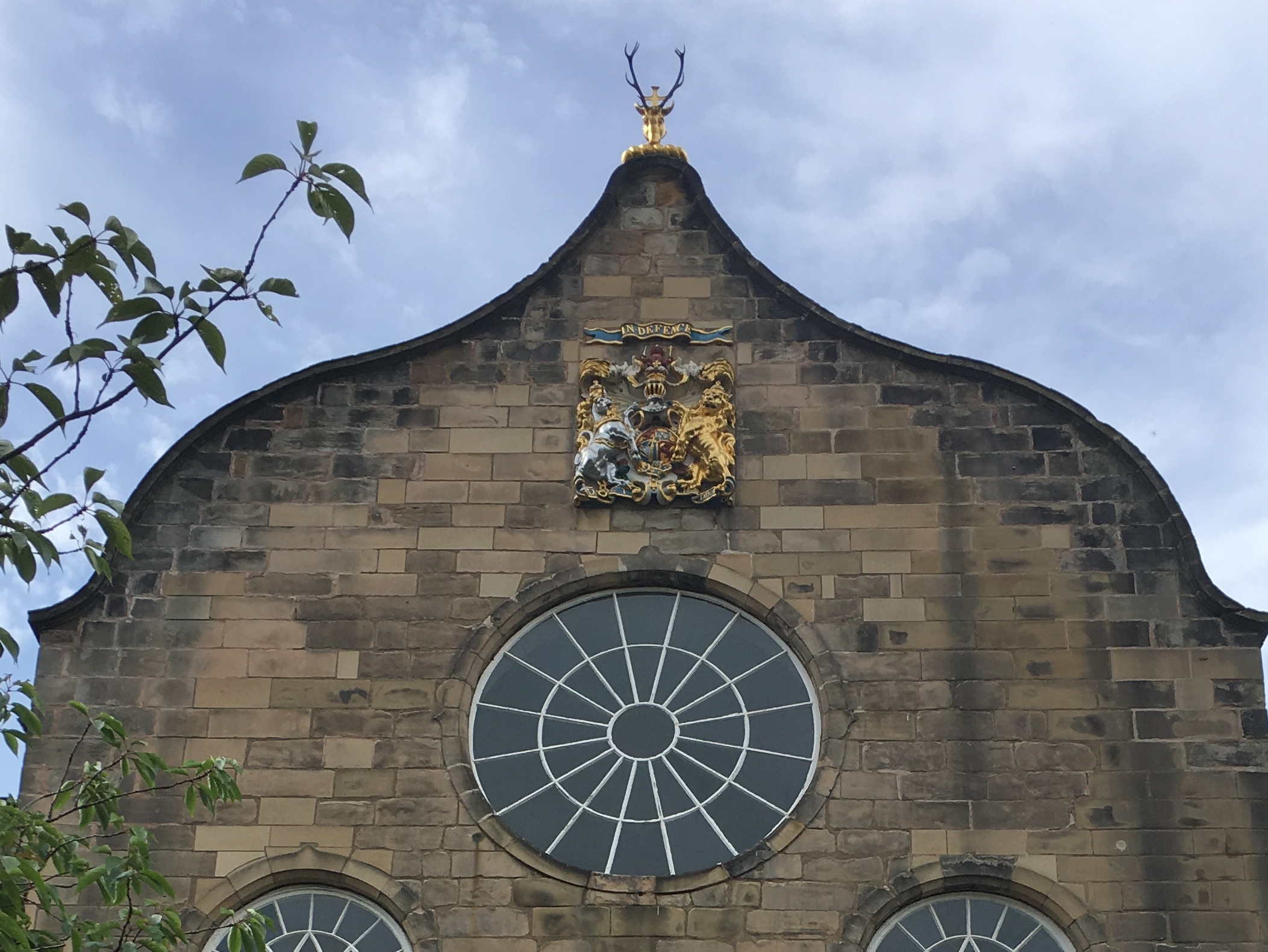
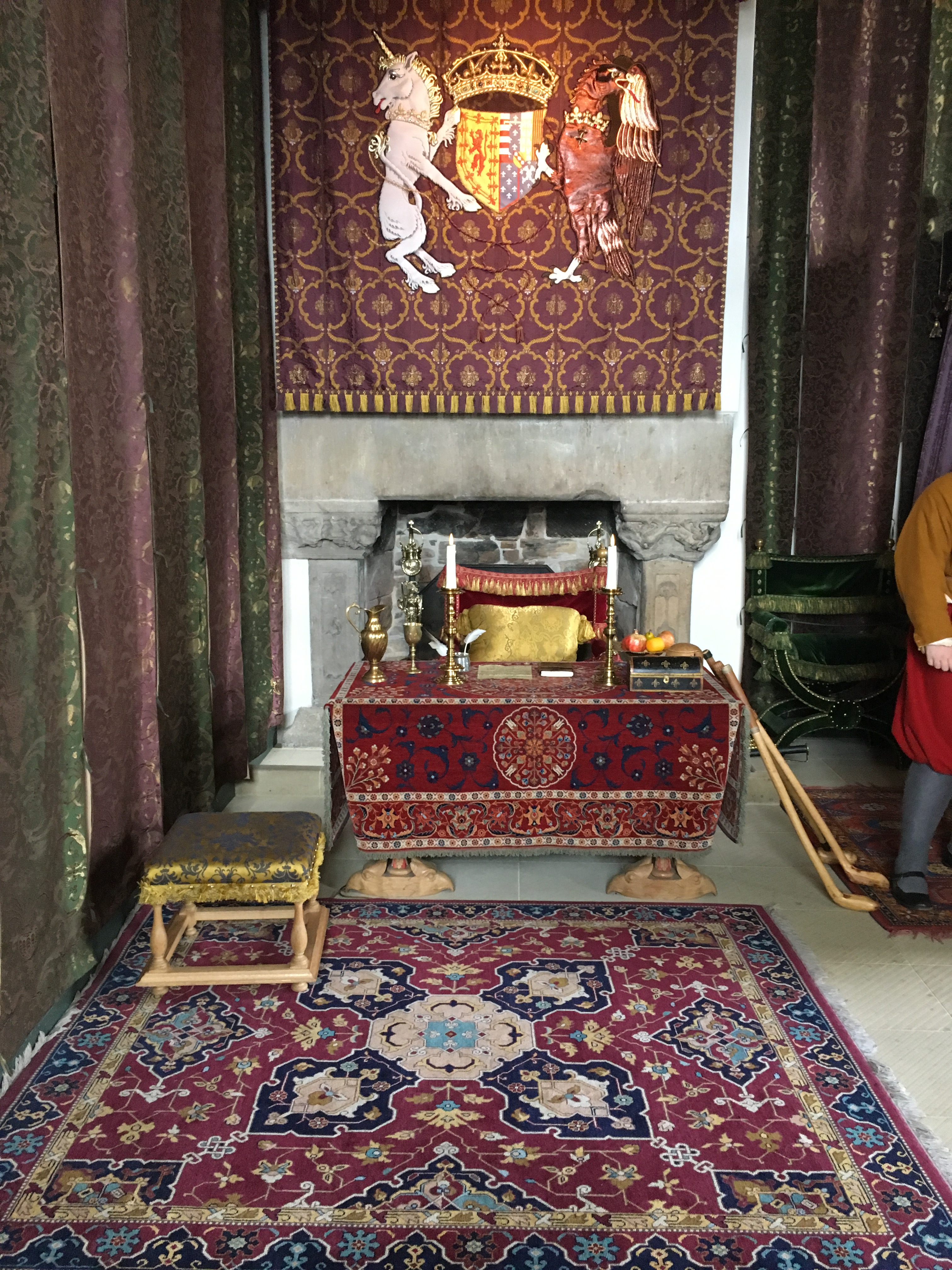
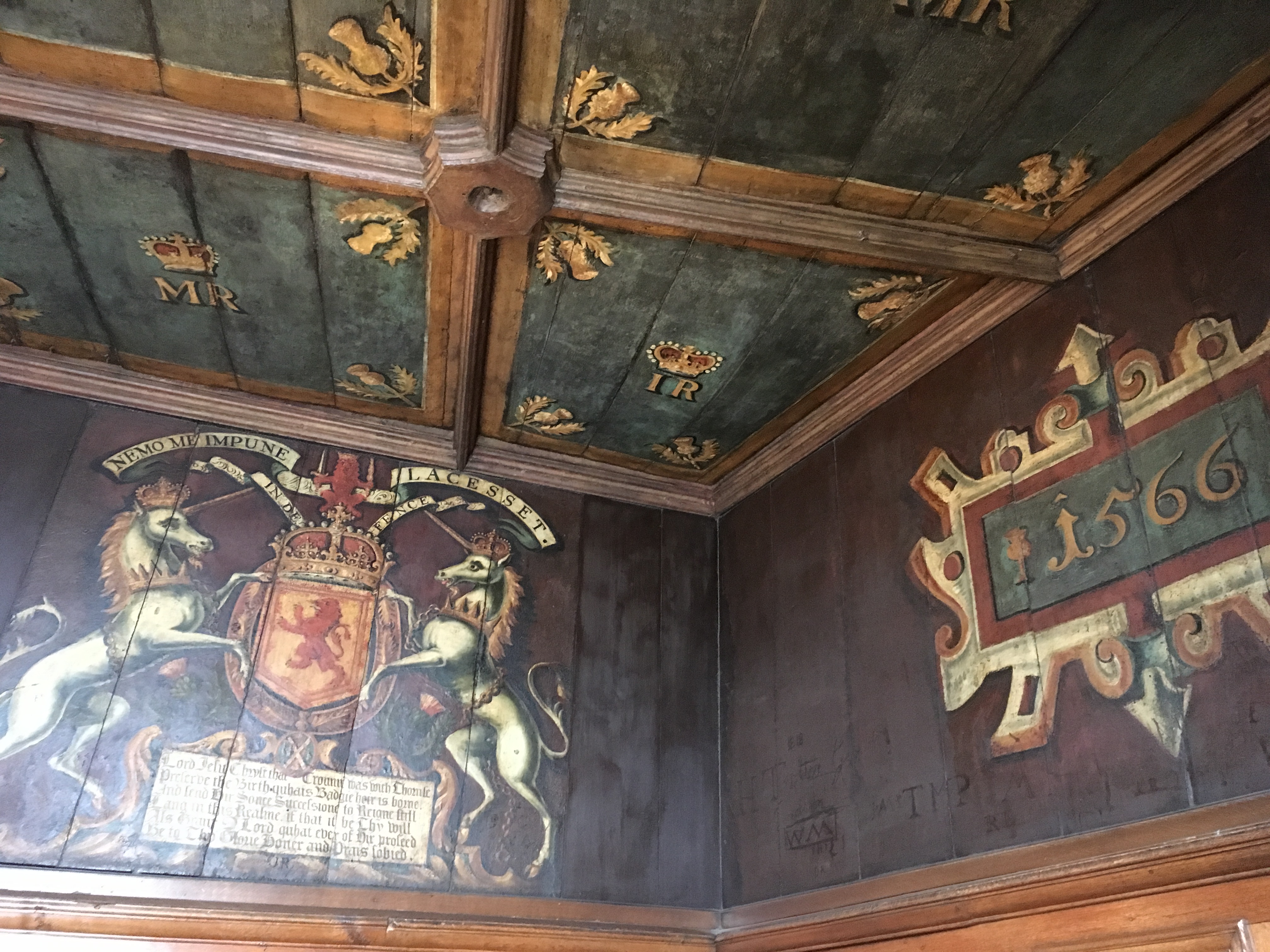
Unicorns are associated with purity, strength and power…they are also proud and untamable—two words people would use to describe Scots throughout history. Since the 15th century, many monarchs of Scotland have used the unicorn in their coat of arms.  Kings favored the mythical beast because they considered it to be the best representation of power. In fact, unicorns are believed to be so strong that only kings and virgin maidens could keep them captive. (Rabbies)

The unicorn plays an important part in Scotland’s identity.

Photos from various places in Scotland including Edinburgh Castle, Doune Castle, Sterling Castle and others.

Photo credit: Tonya Brown

Incorporated on Mary’s kirtle are symbols from her time as queen consort to Francis II of France from 1559-1560. The dolphin symbolizes her husband, the dauphiné of France.  The word dauphiné does in fact mean “dolphin” in English and refers to the region of France that is now Grenoble. When the Lord owning it died, he gave it to the King of France with the conditions that it would be ruled by the heir to the throne.  Hence, the dolphin used on Mary’s kirtle in this image is taken directly from Francis II’s coat of arms. 

The kirtle also holds Mary’s symbol of Queenship in Scotland: the thistle and crown. Mixed among these symbols on the kirtle are the fleur de lis, which symbolizes the French divine right to rule. 

Mary is drawn in an attifet, her famous heart-shaped hat. The dress was inspired by a portrait at the Blairs Museum in Aberdeen, Scotland by an unknown artist.  According to historian Estelle Paranque, “There’s a striking resemblance between the dress in this portrait, which was painted in the seventeenth century, and the costume worn by the actress who played Mary Stuart in Pierre-Antoine Lebrun’s 1820 tragedy (based on Schiller’s 1800 play). The gold and black dress embodies both Mary’s martyrdom and queenship.”

According to historian Estelle Paranque, “There’s a striking resemblance between the dress in this portrait, which was painted in the seventeenth century, and the costume worn by the actress who played Mary Stuart in Pierre-Antoine Lebrun’s 1820 tragedy.

(Photo credit: Gallica)

The original play Paranque refers to is a verse play by Friedrich Schiller’s and was based on Mary’s last days. It later inspired Donizetti to compose his opera, “Maria Stuarda” in 1835. 

The symbols with the name “Marie Stuart” scribed to the right of Mary’s figure are also taken from the same portrait at the Blairs Museum. 

In Mary’s hands are various items which define her. In her left hand is the rosary which she had at her execution and which was, unfortunately, recently stolen from Arundel castle.  In her right hand are riding gloves which denote her love for equestrian sport.  Also in her right hand is her long chained girdle, indicating she is about to read her small girdle (prayer) book. 

Among other sources, research for girdle books can be viewed at the British Art Studies website. There, the portrait of Lady Philippa Speke (nee Rosewell) displays the unusual pose of grasping at a girdle to read a prayer book.  Additionally, this abstract by William Aslet (link below) offers images of exquisitely decorated girdle books.  The actual girdle chain in the drawing of Mary is taken from the Blairs Museum portrait. 

At the onset of this project, Tonya directed me to a wonderful resource on Mary’s clothing: The Fashion Secrets of Mary, Queen of Scots. The link offers insightful suggestions on fabric types and colours. It is here where I first decided on the Blairs Museum portrait.

These dolls were called pippins and according to The Fashion Secrets of Mary, Queen of Scots, were used to help individuals in 16th & 17th century Europe to keep up to date on the latest fashions. Photo credit: Historic Environment Scotland.

I hope this image showcases the magnificence of Mary, Queen of Scots and I also desire that you have as much pleasure studying its meaning and colouring it in, as I did creating it for you. 

With Warm Wishes, 

Rebecca Monet

About the Artist

Rebecca Money is a writer and illustrator who grew up in the state of Maryland in the U.S.  She received a degree in illustration and for nearly twenty years, created custom murals in private homes in Atlanta, Georgia. She has spent the last fifteen as a mother and writer. Her mural clients would jokingly call her “Rebecca Monet.” It wasn’t until her last year of painting murals that her father discovered, through a genealogy-fascinated cousin, her clients were not off the mark.  She has since adopted “Rebecca Monet” as her pen name.  A perennial student at heart, she loves writing, art, history, flamenco and going really fast on carting tracks.  “I think Anne would have especially loved the latter and I enjoy the thought of seeing her, French hood flying, as she beats everyone else to the finish line” ~ RM

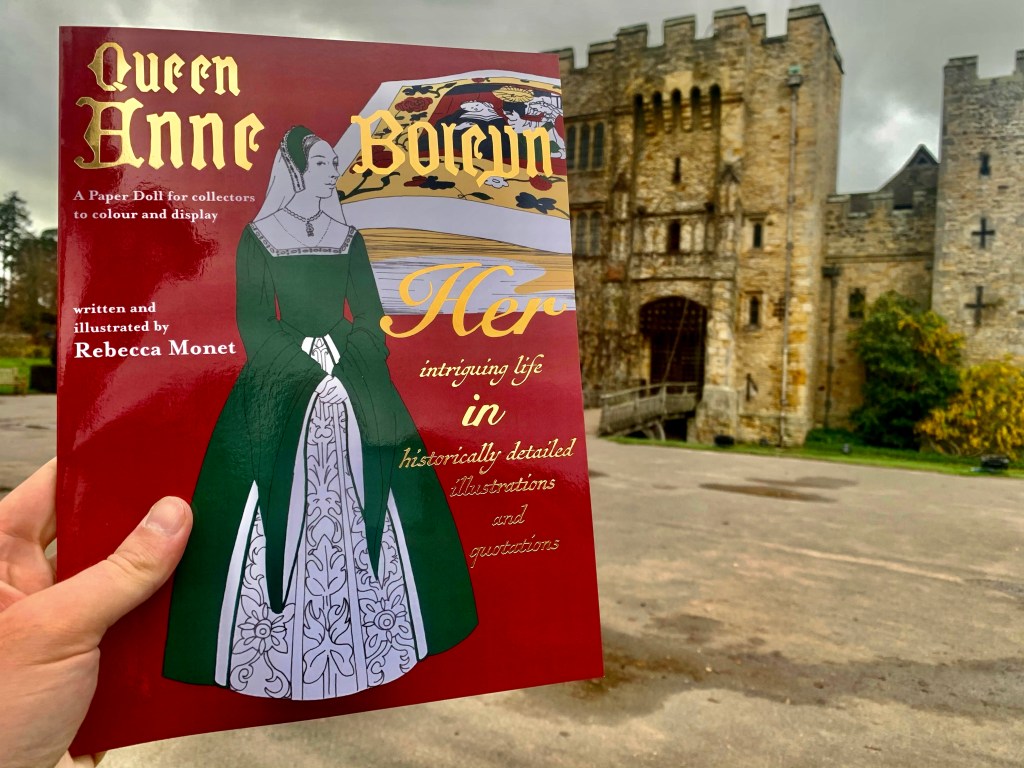
Be sure to check out Rebecca’s Queen Anne Boleyn Paper Doll book at anneboleynpaperdoll.com

References and Further Reading:

Aslet, William.“Article: Negotiating a Courtship between Courts: Hilliard’s Prayer Book Portraits of Queen Elizabeth and the Duc D’anjou, by William Aslet.”

British Art Studies, Paul Mellon Centre for Studies in British Art and Yale Center for British Art, 30 Sept. 2020, https://www.britishartstudies.ac.uk/issues/issue-index/issue-17/negotiating-a-courtship-between-courts. 

Ensign, Alison. “The Fleur-De-Lis: Meanings, Uses, and Facts • • Familysearch Blog.” • FamilySearch Blog, 17 Nov. 2021, https://www.familysearch.org/en/blog/fleur-de-lis-symbolism-and-meaning#:~:text=The%20fleur%2Dde%2Dlis%2C%20sometimes%20spelled%20fleur%2Dde,petals%20attached%20at%20the%20base. 

Grueninger, Natalie and Linda Porter. Reassessing Mary, Queen of Scots’ Reputation, Episode 145, Talking Tudors Podcast, 8 February 2022. https://onthetudortrail.com/Blog/2022/02/12/episode-145-reassessing-mary-queen-of-scotss-reputation-with-dr-linda-porter/

Murdock, J. Paul,. “Mary, Queen of Scots.” A ROYAL HERALDRY, https://aroyalheraldry.weebly.com/blog/mary-queen-of-scots. 

“New Research Reveals Fashion Secrets of Mary Queen of Scots.” Historic Environment Scotland, https://www.historicenvironment.scot/about-us/news/new-research-reveals-fashion-secrets-of-mary-queen-of-scots/#:~:text=Known%20as%20’poup%C3%A9e’%20or%20′,’pippins’%20in%20renaissance%20Scotland. 

Paranque, Estelle. “More Stories.” Mary, Queen of Scots in Art and Literature | Art UK, https://artuk.org/discover/stories/mary-queen-of-scots-in-art-and-literature. 

Rabbles Blog, Clare. “The Unicorn: Everything You Need to Know about Scotland’s National Animal: Scotland’s National Animal, National Animal, Creepy Old Photos.” Pinterest, 10 Jan. 2021, https://www.pinterest.com/pin/644014815462580271/.

Posted in Author Interview

Interview with Ailish Sinclair

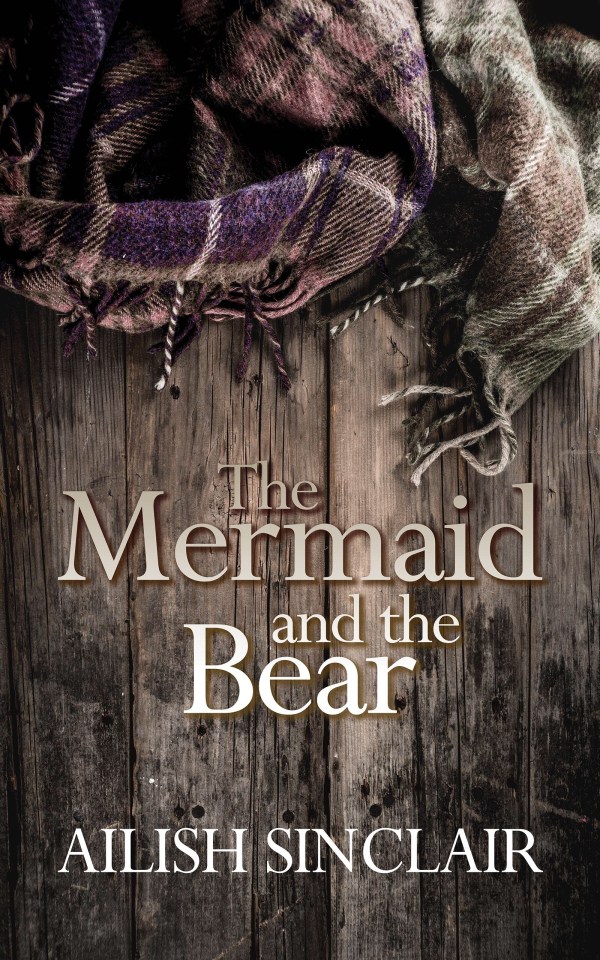
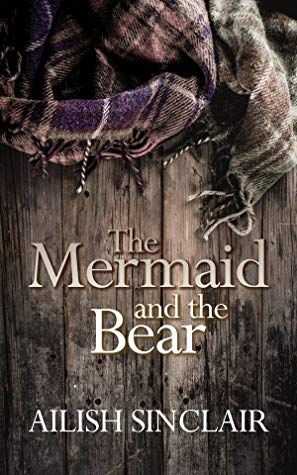
I fell in love with Ailish Sinclair’s writing when I read her first book, The Mermaid and the Bear. She has such beautiful prose and I was hooked immediately into the story which had interesting characters and an intriguing plot.

I was so excited when Ailish agreed to interview with me about her writing process and how she became an author. She lives in Scotland, surrounded by inspiration and beauty and she has taken that awe-inspiring setting and written some fantastic stories that come straight from the heart of Scotland.

Keep reading to learn more about Ailish and her history-inspired books.

Tonya: When did you first realize you wanted to be a writer?

Ailish: When I was 7 years old I started to pen a novel called ‘The Flea Invasion’. The scope of the post-apocalyptic world I’d envisaged was beyond my ability to write, but I knew I wanted to do things like that again.

Tonya: What is your biggest inspiration for stories? Where do you get your ideas?

Ailish: The places and history all around me where I live in Northern Scotland are my greatest inspiration. So much has happened here, much of it rather dark and hidden. The Grampian region has over 150 stone circles, which are mysterious and alluring. One always makes it into my novels! There’s so much natural beauty in the forests and beaches and mountains. All these things infuse and inspire my writing.

Tonya: In your opinion, what is the hardest part about writing historical fiction?

Ailish: It’s knowing when to stop the research and just write the book. There’s always more to know about historical time periods; you could just go on and on researching for years. But the book has to be written and the story matters, so you have to wrench the history books from your own hands and get down to it!

Tonya: Which one of your book characters is your favorite? Why?

Ailish: I love the character of Bessie Thom in The Mermaid and the Bear. She’s so down to earth and wise, and works so hard to do her best for everyone around her. She’s based on a real woman who was accused of witchcraft in 1597 so I hope I’ve done justice to the person she was.

Tonya: Have you ever written a character that you absolutely disliked and if you were to meet the character in real life you know you wouldn’t like them?  Which character and why are they so detestable?

Ailish: William Dunn, Dean of Guild, from The Mermaid and the Bear. He’s a villain, so obviously he’s not meant to be liked, based on a real person who made a profit from the witch hunts. I have instilled in him traits and attitudes of misogynistic and abusive people I’ve encountered in my own life and know I would physically recoil if I were to meet him.

Tonya: What is your favorite time period to read? Is that also your favorite time period to write in?

Ailish: I love to read the medieval period and also the dark ages. I have not actually written anything set exactly in those times but I would love to.

Tonya: Do you have authors that you feel have influenced your writing or inspired you?

Ailish: I’ve been reading novels by Mary Webb, the Bronte sisters, Elizabeth Goudge and Mary Stewart since childhood and they have all influenced my writing.

Tonya: What is the biggest obstacle in your writing process?

Ailish: Self doubt. Is it really good enough? Is it, in fact, bilge? Or nonsense? Or the worst thing that has ever been written in the whole history of the world? Like stopping the research, this is something you just have to be strict with yourself about, or decide to just write it anyway, bilge or not.

Tonya: How long did it take you to write your book? If you have more than one, which took the longest to write?

Ailish: The Mermaid and the Bear poured out of me at just over a thousand words a day, so in two months I had a short first draft, writing for about an hour a day. I then redrafted twice in the next month and sent it out. That’s the fastest I’ve ever managed. The book I’m working on just now is very different from that. I’ve literally been writing it for years!

Tonya: What are you currently working on?

Ailish: I’m working on an Iron Age novel, set in Aberdeenshire again. My usual stone circle is there but, of course, the castle is not. The main character is a non-verbal autistic woman who is the spiritual leader of her community. There’s some sexy Romans and Caledonians too…

Tonya: What inspired you to write the book you are currently working on?

Ailish: I like mystery when it comes to historical events, and the battle of Mons Graupius between the Romans and the Caledonian tribes intrigued me. Where did it take place? What really happened there? What would it have been like to live through such an event? I’m enjoying exploring all those questions.

Tonya: What words of wisdom would you share with inspiring authors?

Ailish: Just keep writing. Don’t let other people tear you down and tell you you’re doing it wrong or that you should be published by now. Unless they’re actual experts who you’ve chosen to consult, the advice will undoubtedly be wrong. People have strange agendas when it comes to the writing of others. Do your own thing. Go your own way.

Ailish Sinclair spent the earlier parts of her life dancing around and encouraging others to do the same. She now lives beside a loch with her husband and two children, surrounded by castles and stone circles, where she writes and dances (yes, still) and eats cake. 
Connect with Ailish at the following sites and check out her books!

Website: https://ailishsinclair.com/

Twitter: https://twitter.com/ailishsinclair/

Facebook: https://www.facebook.com/ailishsinclairauthor/

Instagram: https://www.instagram.com/ailishsinclair/

Isobell needs to escape. She has to. Her life depends on it.

She has a plan and it’s a well thought-out, well observed plan, to flee her privileged life in London and the cruel man who would marry her, and ruin her, and make a fresh start in Scotland.

She dreams of faery castles, surrounded by ancient woodlands and misty lochs… and maybe even romance, in the dark and haunted eyes of a mysterious Laird.

Despite the superstitious nature of the time and place, her dreams seem to be coming true, as she finds friendship and warmth, love and safety. And the chance for a new beginning…

Until the past catches up with her.

Set in the late sixteenth century, at the height of the Scottish witchcraft accusations, The Mermaid and The Bear is a story of triumph over evil, hope through adversity, faith in humankind and – above all – love.

Elizabeth craves adventure… excitement… love…

For now though, she has to settle for a trip from her family’s castle, to the port in Aberdeen, where her father has promised she’ll be permitted to buy a horse… all of her own.

Little does she suspect this simple journey will change her life, forever. And as she dreams of riding her new mount through the forests and glens of the Manteith estate, she can have no idea that she might never see them again.

For what lies ahead is danger, unimagined… and the fearful realities of kidnap and slavery.

But even when everything seems lost, most especially the chance of ever getting home again, Elizabeth finds friendship, comfort… and that much prized love, just where she least expected it.

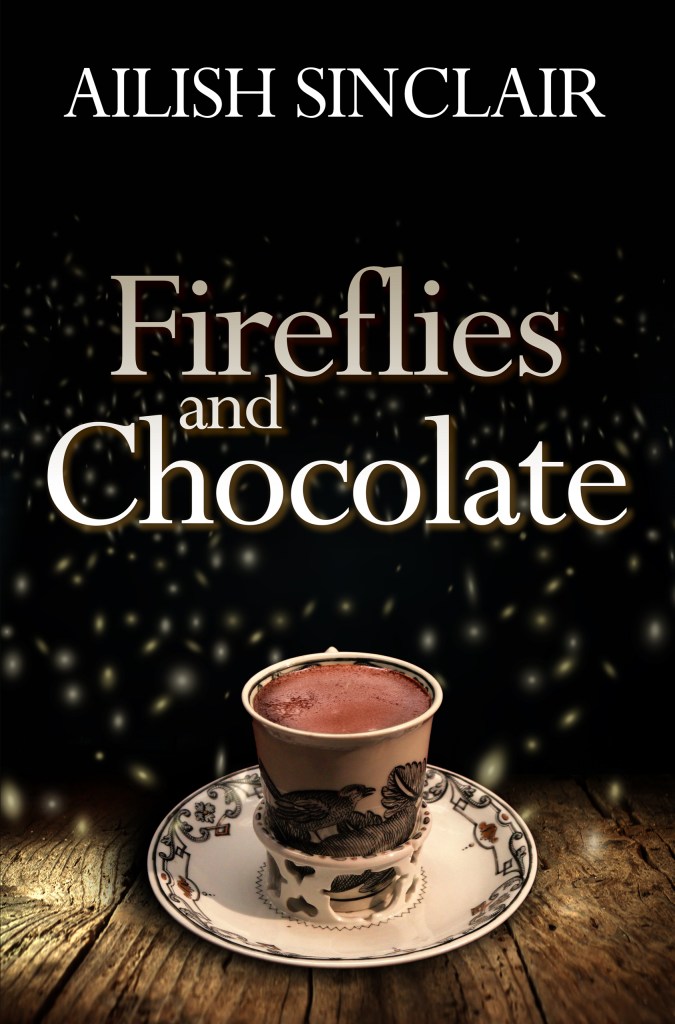
Set in the mid eighteenth century, Fireflies and Chocolate is a story of strength, courage and tolerance, in a time filled with far too many prejudices.

Posted in Historic Characters

Rival Queens: Mary, Queen of Scots & Queen Elizabeth I

Mary Queen of Scots & Queen Elizabeth I. If only they could have been friends. 

💔

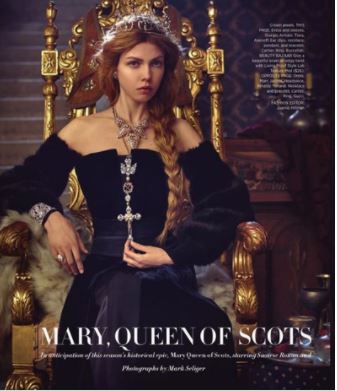
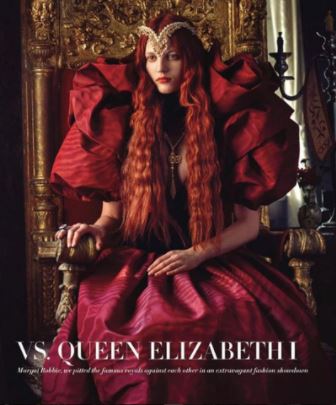
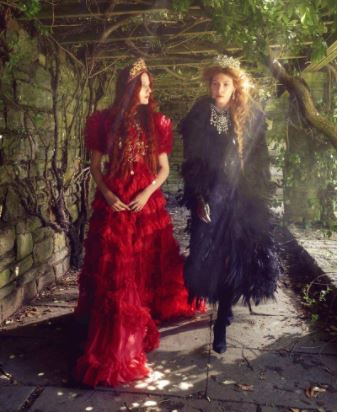
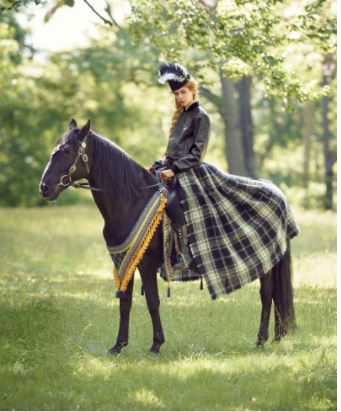
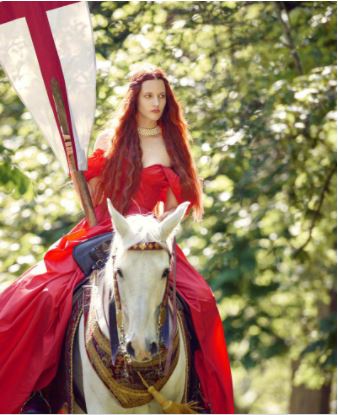
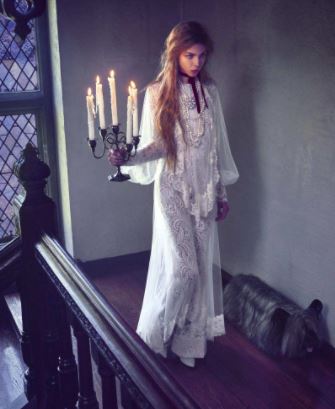
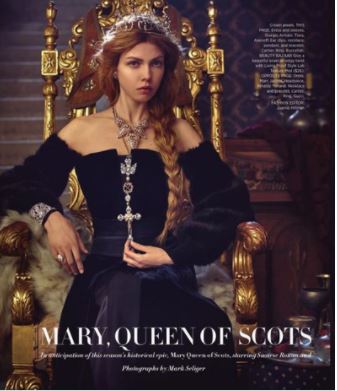
I recently came across some gorgeous photos from Harper’s Bazaar with model’s posing as the rival queen cousins, Mary Stuart and Elizabeth Tudor. This got me thinking about the turbulent relationship between the two women and I thought I’d jot a quick blog about it.

Mary looked up to her dear cousin, Elizabeth, who was nine years older than she. She wrote to her often, entreating her for guidance and trying her hardest to please Elizabeth in her choice for a second husband.

The two queens exchanged gifts with their letters and Mary also attempted to arrange a meeting with Elizabeth but it never worked out.

But as Elizabeth dithered on her choices for Mary and drug her feet after suggesting Mary marry Elizabeth’s favorite, Robert Dudley, Earl of Leicester, the Scottish queen decided to take matters into her own hands. Relations quickly deteriorated between the Cousin Queens when Mary exerted her right to choose her own husband. <enter Henry Stewart, Lord Darnley>

Robert Dudley, Earl of Leicester. Artist Unknown.
Elizabeth put Dudley forth as a possible suitor because she knew he would be loyal to her and could keep an eye on Mary. When Mary reluctantly agreed to meet him, Elizabeth began having second thoughts.
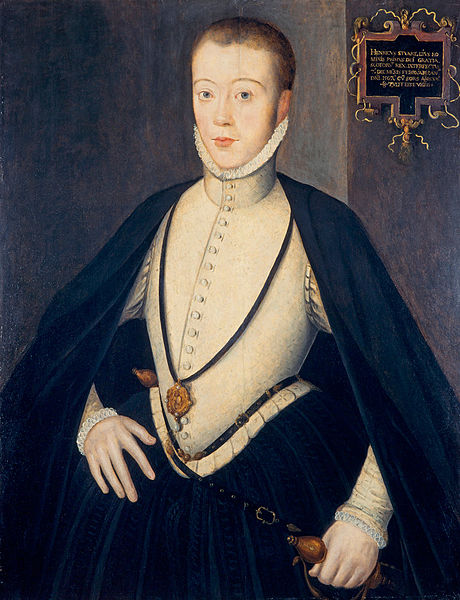
Mary’s second husband, Henry Stewart, Lord Darnley.
Artist Unknown.
In Mary’s eyes Darnley was the perfect choice, as he also held a legitimate claim to the English throne. This made him a terrible choice in Elizabeth’s eyes.

Mary tried to persuade Elizabeth many times to name her as her heir, especially the older Elizabeth got and it became apparent that she would never marry and birth a child. At one point Elizabeth even admitted that she preferred Mary over another cousin and heir-in-line, the Protestant Lady Katherine Grey. Lady Katherine was the granddaughter of Henry VIII’s youngest sister, Mary.

Lady Katherine Grey. Artist: Michael Stinnett. Although a Protestant, Katherine angered Elizabeth by marrying without her consent, therefore putting her out of favor as a choice for Elizabeth’s heir.

When Mary fled to England to escape the wrath of her Scottish lords, she still held out hope that she would find favor with her cousin. But it was not meant to be.

Elizabeth had Mary arrested and held her under house arrest for the next 19 years before signing Mary’s death warrant. Mary was beheaded with her cousin’s approval, at the age of 44.

Although portrayed together in paintings, movies, and photos, the two queens never met.

Harper’s Bazaar U.S. retrieved from models.com

Photographer: Mark Seliger
Models: Julia Banas as Elizabeth and Lea Julian as Mary

To see the rest of the photos in this beautiful photo shoot, click here.

Posted in Historic Characters

The First Executed Witch in the North Berwick Witch Trials

What were the North Berwick Witch Trials?

The North Berwick witch trials were held to examine several people who were accused of witchcraft in Scotland starting in 1590.

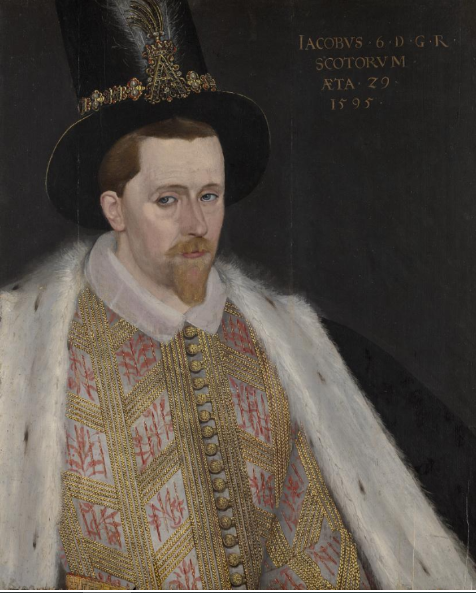
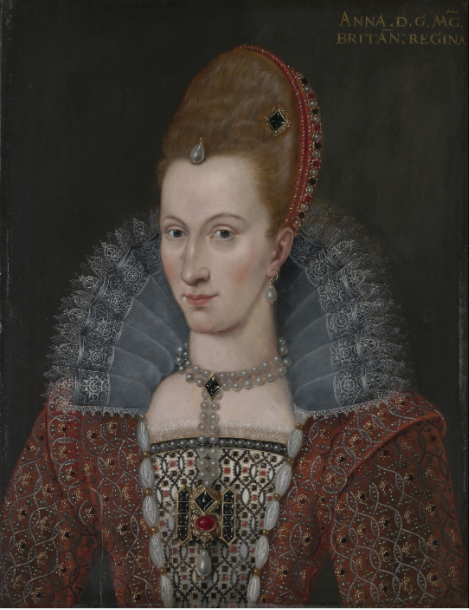
King James VI of Scotland married Anne of Denmark in a proxy marriage ceremony in 1589. But when it came time for Anne to sail to Scotland to meet her new husband, that is when the real trouble began.

Anne’s ship was delayed by storms for so many months that James decided to sail to Norway, where she was stuck, and retrieve her. He too, had issues with the storms, but they finally reached Scotland in 1590.

  • Portrait title: James VI and I, 1566 – 1625. King of Scotland 1567 – 1625. King of England and Ireland 1603 – 1625. Artist unknown but attributed to Adrian Vanson.
  • Portrait title: Portrait of Anne of Denmark (1574-1619) by Unknown Artist.

It was during this turbulent time that it was first brought to James’ attention that witches might be responsible for the storms that caused the delay in Anne’s travels (and also caused the death of one her maids). Witchcraft and the hunting of witches was very popular in other parts of Europe at the time and James began to make serious inquiries into the possibilities. Eventually a woman name Geillis Duncan who lived in the town of Tranent, was arrested. She went on to accuse several more people of being witches and a true witch hunt began.

Not All Accused Witches Were Women

At least three of the names that Geillis Duncan gave her accusers were men. One of these men was a schoolmaster from Prestonpans by the name of Doctor Fian, who went by the alias, John Cunningham. It was said he was the witches’ register, and  that there was not one man who could come to the devil’s readings but only he.

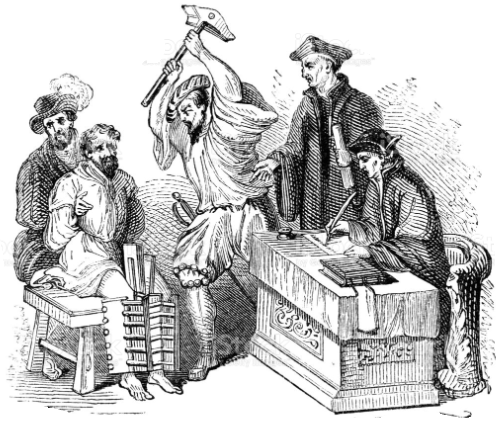
Once he was arrested, Doctor Fian had his head thrawed, whereby a rope would be wrapped around the head and squeezed. This did not have the effect his accusers had hoped, and he confessed nothing. He was also put in the “boot” which was a wooden or metal device into which wedges were hammered thus crushing the feet and lower legs. Yet, he still would not confess. The other accused witches urged his accusers to search his tongue, whereby two pins were found underneath, pressing up into his tongue. The witches claimed that the charmed pins were the reason Doctor Fian could not confess. He was immediately released from the boots and brought before the king where his confession was taken, written in his own hand.

Love-Sick Schoolmaster?

Along with his admittance of recording the witches’ confessions of service and true oath to the Devil, he would write whatever the Devil commanded him.  Doctor Fian also admitted to bewitching another man in town who had an interest in the same young woman that Doctor Fian did. He caused the man to fall into a state of lunacy for the span of one hour, every 24 hours. This young man was brought before King James to testify and it was witnessed that he did indeed fall into madness, bending himself and capering directly up, so high that his head would touch the ceiling. It took several men to subdue the man and once he was bound hand and foot, he was left to lie still until his fury had passed. Once the bewitchment was over, the man had no recollection of the events. 

Doctor Fian was also accused of trying to bewitch the young woman that he was in love with. Having enlisted the help of one of his students, who happened to be the brother of the woman he was in love with, he attempted to obtain “three hairs of his sister’s privities”. Doctor Fian gave the young man a piece of paper to wrap the hairs in to be brought safely back to him.  The young man pestered his sister so much that she brought it to her mother’s attention.

Her mother (who was said to also be a witch), began to inquire of the brother what he was trying to do. She finally beat a confession out of him and he told her all that Doctor Fian had asked him to do. Wanting to give the schoolmaster a taste of his own medicine, she then proceeded to snip three hairs from the utter of a heifer and wrapped them in the paper that Doctor Fian had given to her son. 

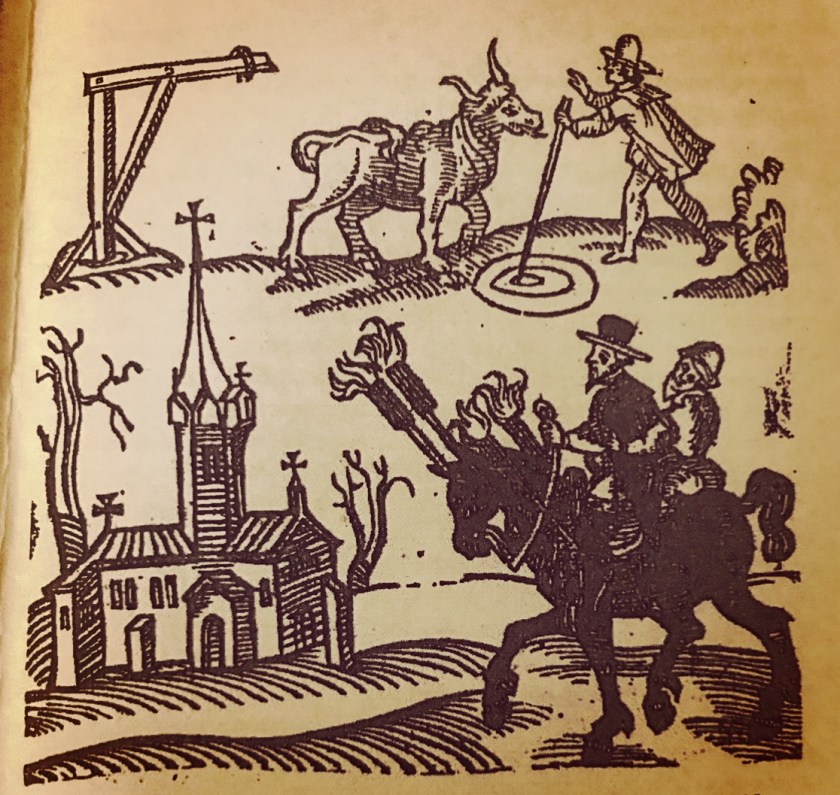
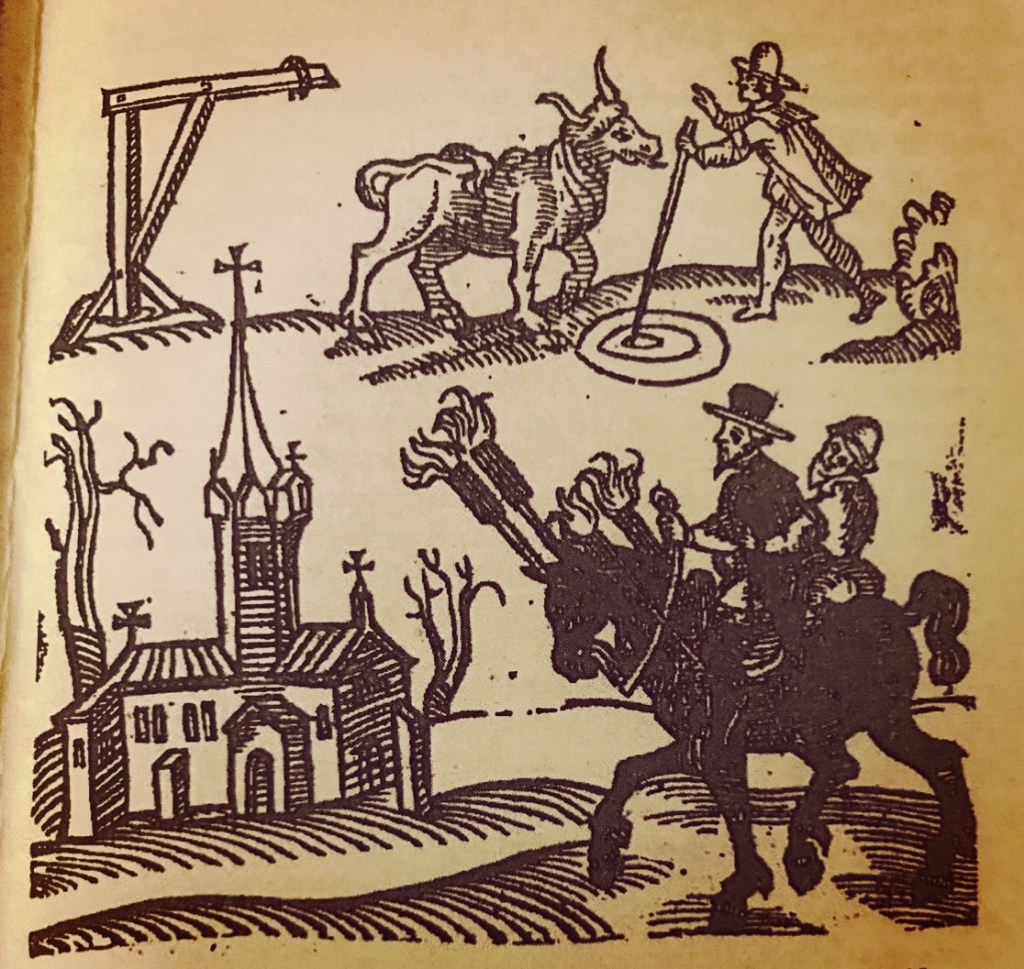
When Fian used the hairs in an attempt to cast his love spell, you might imagine what happened next! According to contemporary accounts, he had no sooner done his intent to them, that the heifer appeared at the door of the church where the schoolmaster was. The cow came through the doors of the church and made toward him “leaping and dancing”, and followed him out of the church and wherever he went. 

According to the writer of Newes from Scotland, this was witnessed by many of the townspeople who recognized that such acts could never have been sufficiently effected without the help of the Devil. It became such an ordeal that Doctor Fian came to be known amongst the people of Scotland as a notable conjurer. 

An Apparent Change of Heart

Doctor Fian eventually recanted his allegiance to the Devil and renewed his confession of Christ. He pledged to live a godly life and eschew all that the Devil had asked of him. But the morning following his confession, Fian revealed that the Devil had visited him in the night and demanded that he continue his faithful service. The Devil had appeared to him dressed all in black with a white wand in his hand. Doctor Fian claims he rebuked the Devil, telling him that he would no longer take part in that lifestyle. He also claimed that the Devil then told him “once ere thou die, thou shalt be mine”. The Devil then broke the white wand and immediately vanished. 

Doctor Fian told these events to his accusers the next morning and remained in solitary confinement throughout the day. He appeared to ponder the care of his own soul and would call upon God indicating a penitent heart. However, that very same night, Fian was able to apprehend a key to the cell in which he was kept and escaped the prison.

The king immediately issued public proclamations throughout the land in an effort to apprehend Doctor Fian. According to Newes from Scotland, a hot and hard pursuit ensued, and he was eventually recaptured.

Although the schoolmaster had confessed his sins in his own handwriting, he denied now that he had ever had such a pact with the Devil. The king, perceiving that Fian had renewed his allegiance to the Devil during his absence from prison, commanded he be searched again for a mark indicating his new pact. He was thoroughly searched, but no mark could ever be found. 
More torture was ordered and it was done in this manner:

**SENSITIVITY WARNING**


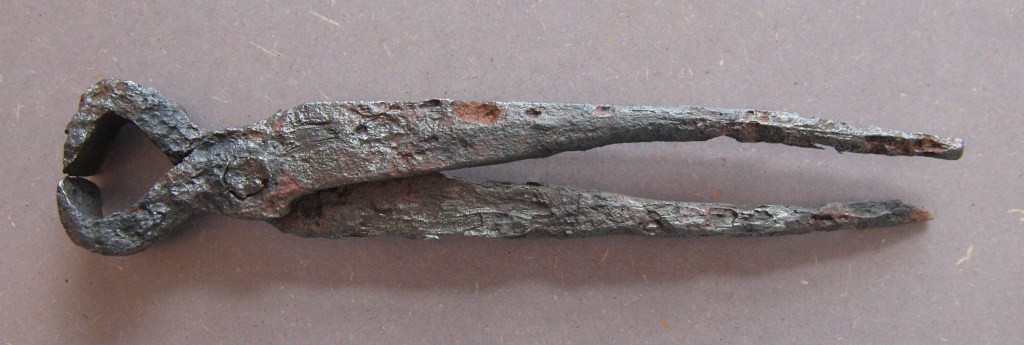
All his fingernails were split with an instrument called a Turkas (pincers)  and two needles were pushed up under each nail up to the heads. The Doctor felt nothing and confessed to nothing from this torture.

He was then put to the boot again. He remained in the boots for a long time, enduring many blows insomuch that his legs were “crushed and beaten together as small as might be, and the bones and flesh so bruised, that the blood and marrow spouted forth in great abundance, whereby they were made unserviceable forever.” For more information about how the boot was used as a torture device check out this website here.

Example of a boot used for torture

Yet, he still would not confess. 

His accusers claimed that the Devil had entered his heart so deeply that he utterly denied all that he had previously confessed. Doctor Fian claimed that he had only made such confessions for fear of pains which he had endured. 

Pincers from the archaeological excavation at the Harburger Schloßstraße in Hamburg-Harburg, Germany. Dated to approx. 15th or 16th century. Photoraphed at Archaeological Museum Hamburg. Photo credit: Bullenwächter; Wikipedia CC

After great consideration by the king and His Majesty’s council, in the name of justice and “also for example’s sake”, Doctor Fian was soon condemned to death. 

According to Newes from Scotland, he was strangled, carried in a cart to Castle Hill of Edinburgh and put into a great fire and burned. 

Doctor Fian was the first accused witch executed in the North Berwick witch trials.  There would be many more.

Woodcut featured as a scene from the life of Doctor Fian’s life, in Newes from Scotland, published 1591.

Posted in Book Review

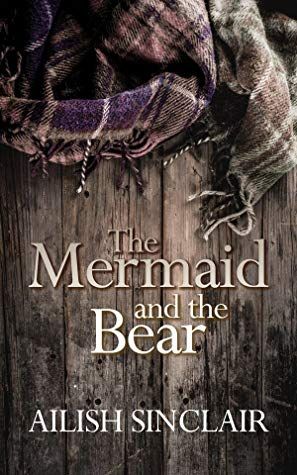
The Mermaid and the Bear

Book Title: The Mermaid and the Bear

Author: Ailish Sinclair

Time Period: Late 16th Century

Setting: Scotland, during the reign of King James VI

My Rating:

Before I go any further, I just have to say, this is one of the most beautifully written books I have ever read. Yes, it is written in one of my favorite time periods, and yes it takes place in one of my favorite places in all the world, but when you combine that with the almost poetic style of Sinclair’s writing—sigh!

Ok, I know it sounds like I’m gushing, and maybe I am, but deservedly so. Sinclair’s development of characters is charming, making you love the characters she loves and hate the characters that she hates. Or, if she doesn’t hate them, she sure does a good job at making me do it for her.

Isobell is an English girl trying to escape the prospects of an abusive marriage to a wicked man. She comes up with a plan to escape to Scotland, leaving her privileged life behind to serve as a kitchen maid on the estate of the young Laird, Thomas Manteith. Isobell finds solace in the beautiful and spiritual countryside of Scotland and I loved viewing her world and experiencing it all over again through her eyes. From the flowering trees, the birds and other wildlife to the ancient stone circles and rocky cliffs of this magical land, Sinclair’s writing is a treat for the senses.

The storyline is beautiful too. The love Isobell shared with her “light of the world and salt of the earth” as she called him, was well written, leaving no room for doubt of the love they shared for each other, yet without some of the awkward details that other stories offer.  And while I enjoyed experiencing all the wonderful sights (and feels!) with Isobell, I was always waiting for the proverbial “other shoe to drop”, and Sinclair did not disappoint!

I have read several books having to do with witch trials, from the North Berwick witch trials in Scotland, to the Salem witch trials in America. All have been well written, but Sinclair’s description of not only the treatment of the accused witches and the bodily harm that they endured, but the spiritual, mental and emotional trauma that these accused women (and men, at times) must have endured, is brilliant.

I also enjoyed Isobell’s exploration of Celtic spiritualism, Catholic rites and Reformed practices as she sought for her own truth. It is an excellent example of Scotland’s own spiritual journey throughout history.

I will read this book again. Now that I know there is a beautiful end for Isobell (admittedly not the end I was expecting!), I will read it for the pure enjoyment of meandering the deeply moving countryside of Scotland once more.  

If you would like to see more of Ailish Sinclair’s writings or see her beautiful pictures of Scotland, visit her on her blog at https://ailishsinclair.com/

To purchase a copy of The Mermaid and the Bear click here.

Posted in Animals

Mary, Queen of Scots’ Faithful Dog

Hi everyone! I just wanted to do a quick post, inspired by Louise’s challenge on Instagram at Ahellaloadofhistory. I’ve been participating in her 30 day history challenge and Day 10 asks for you to share an obscure history fact.

I don’t know how “obscure” this fact is that I wanted to share, but I thought it was kind of neat so, here it is.

For the Love of Dogs

Mary Stuart was taken to France when she was five years old with the intention that she would one day marry the French Dauphin, Francis. It has been said that when she first arrived at the French court, she stuck closely to her maids that had accompanied her, and was content with a group of about 20 dogs that lived at court.

Mary always kept dogs, and it appears that the Maltese was one of her favorite breeds. She also favored terriers, and it was a terrier that made it into the (obscure) history books on the day of her execution.

A Faithful Friend

Mary was taken prisoner in England in 1568, and was held for 19 years. She was allowed to keep dogs throughout her captivity.

One eyewitness account tells of her tiny dog that had hidden within the folds of her skirt on the day of her execution. Of the event, Robert Wingfield wrote:

Then one of the executioners, pulling off part of her dress, espied her little dog, which was under her clothes, which could not be gotten forth but by force, and afterwards would not depart from her dead corpse, but came and laid between her head and shoulders (a thing diligently noted: ) the dog being imbrued with her blood, was carried away and washed, as all things else were that had any blood, except those things that were burned.

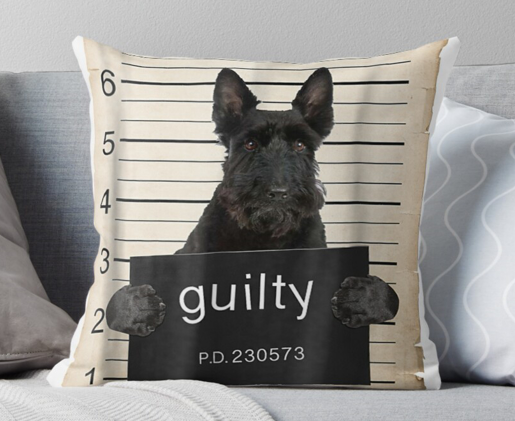
Wingfield’s account does not clarify the color or type of dog that wouldn’t leave Mary’s side. And many tales have grown up around this little detail of Mary’s death. Some had said it was a white dog, others say it was black. Some say it was a Skye Terrier. Although some professional dog breeders claim that the Skye Terrier didn’t come into existence until the 19th century, leaving people to believe that perhaps it was a Scottish Terrier that was so devoted to her.

skye terrior
The cutest Skye Terrier you will ever see! (no photo credit available)


Scottish Terrier at Redbubble
Scottish Terrier (product/photo credit to creator thanhdang at Redbubble.    

Mary’s Dog in Literature and Pop Culture

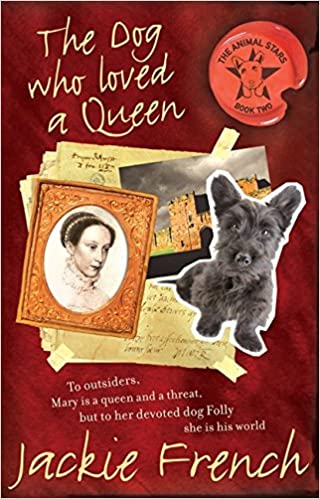
I came across a really cute book that I want to get for my 4th grade classroom library. The Dog Who Loved a Queen, by Jackie French tells the story of Folly, Mary’s canine companion that accompanied her to the executioner’s block. This is a fictional book, told from Folly’s point of view. I am always on the lookout for ways to incorporate the time periods that I love to study and read about into my classroom. I enjoy sharing other historical time periods with my students that do not fall within the confines of our standard curriculum.

Click on the book cover if you’d like to check out this book.

The Dog Who Loved a Queen


You will also find a fuzzy little canine appearance in The Queen’s Almoner. You can read about Tom Tom the pup here.


Maltese_puppy.jpeg.jpeg
Maltese puppy and inspiration for Tom Tom in The Queen’s Almoner. Photo courtesy of Wikipedia under the Creative Commons license.


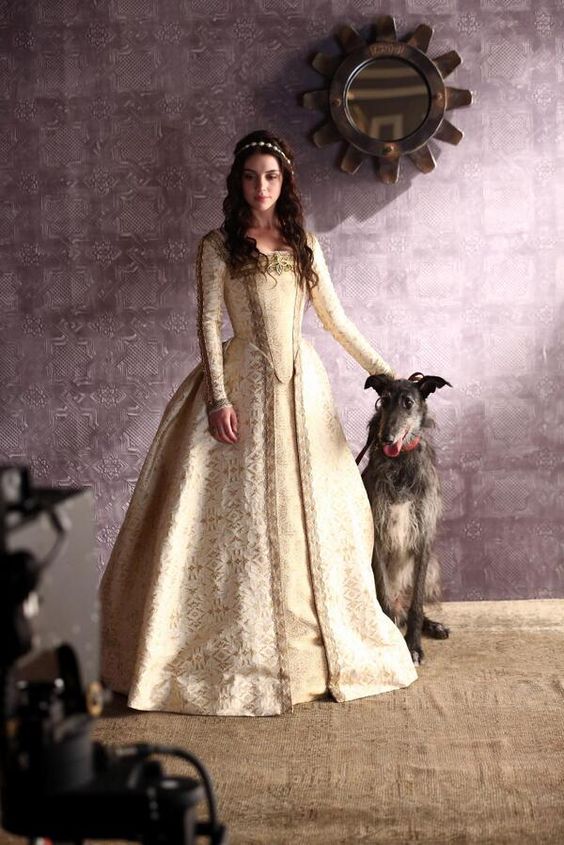
I am not a big fan of Reign, but I found this lovely picture on Pinterest of Adelaide Cane, dressed as Mary Stuart alongside her deerhound, Stirling.

Reign-Mary with Irish Bloodhound
Pinterest. No photo credit available.


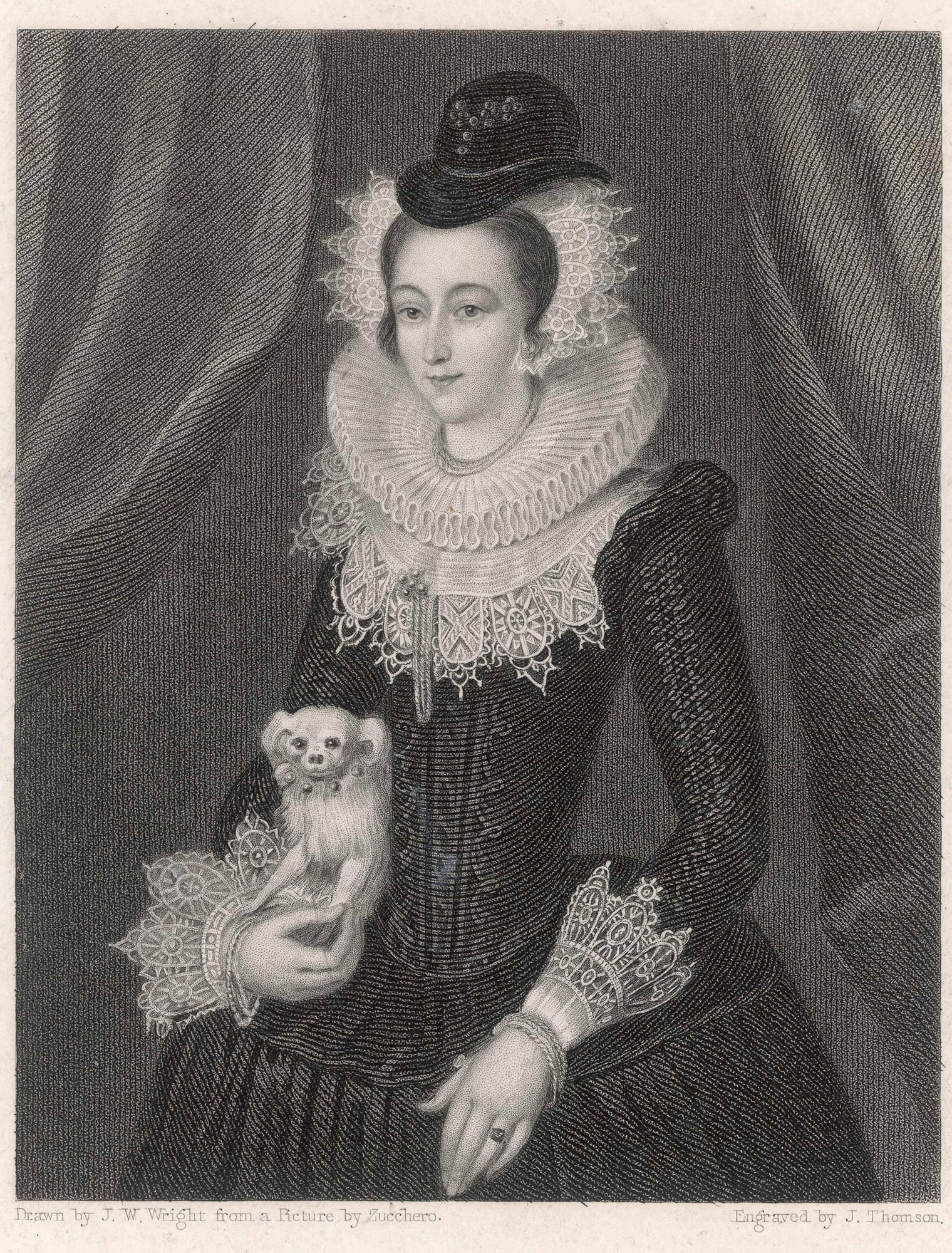
Mary-Queen-of-Scots and maltese
Mary, Queen of Scots with her Maltese. Drawn by J.W. Wright, based on image by Zuccero.


Until next time, Long May She Ever Live in Our Memories.

Tonya


Posted in Churches and Chapels

Greyfriars Kirkyard

Greyfriars Kirkyard was founded in Edinburgh, a year after Mary Queen of Scots returned to Scotland. Opening in 1562, it was to replace the overcrowded graveyard of St Giles. The location for Greyfriars was chosen because it was not right in the center of town, eliminating concerns of smell in the warmer months.

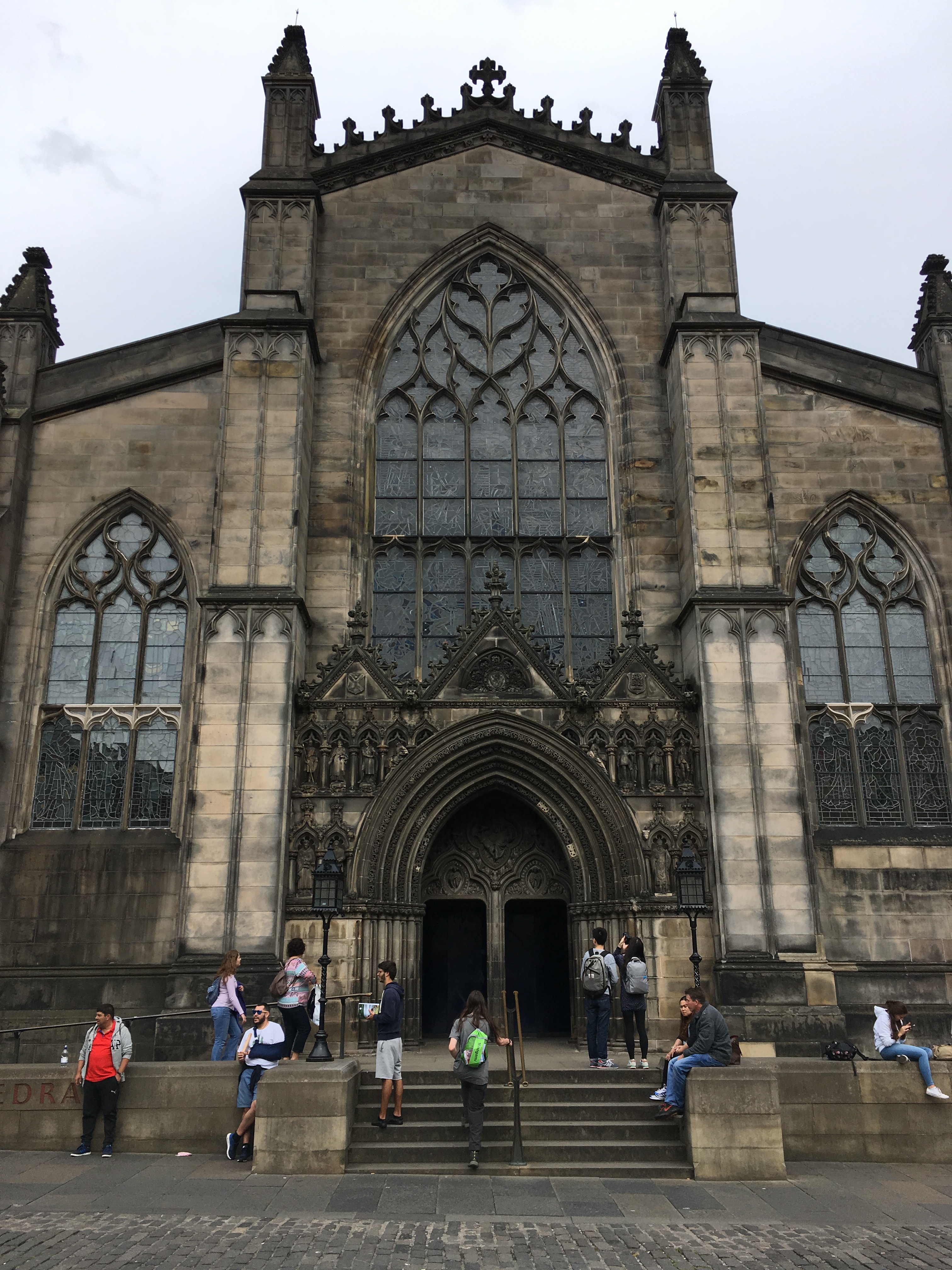
st giles 2
St Giles Cathedral in Edinburgh. When the kirkyard here became full, a new one was started at Greyfriars Kirk.

The Kirkyard was used as a prison for Covenanters in the 1600s, and was a part of their history from the very start, as Greyfriars Kirk was the place where they first signed the National Covenant in 1638.


The Kirkyard was also the sight of many body snatchings during the 18th & 19th centuries, when there was a need for corpses for important medical research and instruction.

There are many notable statesmen, doctors, poets, and theologians buried in Greyfriars Kirkyard, but the two I found of most interest have been buried there since the 16th century.  Historian and reformer, George Buchanan is buried in Greyfriars. I found this interesting because I can trace my ancestry to some Buchanans from Stirlingshire, and have often wondered if I am related to the historian. James Douglas, the 4th Earl of Morton, who makes an appearance in my book, The Queen’s Almoner, is also buried there.

Another interesting burial is that of Greyfriars Bobby. Local legend says that Bobby was a Skye Terrier who guarded the grave of his master, John Gray, after the night watchman died in the mid-1800’s. The dog never left his master’s grave until he himself died 14 years later, exemplifying the ultimate act of loyalty.

Other local legends include the haunting of Greyfriars Kirkyard, and you can even take a guided ghost walk there when you visit Edinburgh. Sorry, I don’t have any pictures of Greyfriars Kirkyard ghosts to share. Image result for Laughing Emoji

For more information about Greyfriars Kirk or Kirkyard you can visit at https://greyfriarskirk.com/visit/kirkyard/

All pictures are my own. You can click on any pic to enlarge for detail. The tombs are amazing!


IMG_0092


Posted in Principal Players Series

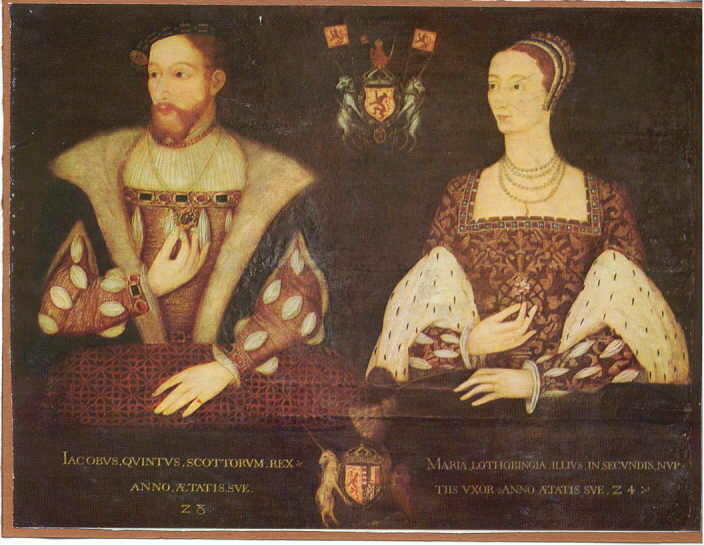
King James V of Scotland and Mary of Guise ~ Father & Mother of Mary Queen of Scots

*Please note: this post is part of a series. To read the parent post click here*

A Rough Start

James V of Scotland was just a toddler when his father, James IV died during the Battle of Flodden Field, making him the next King James of Scotland. He was the fourth child and only surviving legitimate son of James and his wife Margaret Tudor (sister of Henry VIII).
Born in April 1512, he was crowned in September of the following year, becoming the seventh monarch of the Stuart Dynasty. Too young to rule, his mother ruled as regent for a spell. When she married Archibald Douglas, 6th Earl of Angus the following year, she unknowingly forfeited her rights to rule as James’ regent. In her place, the king’s uncle, John Stewart, 2nd Duke of Albany became regent.
Albany was pro-French, renewing the Auld Alliance that would promise James a royal French bride. With French sentiments in Scotland strengthened, the king’s mother fled to England and stayed there for some time. When Albany left Scotland on business, Margaret returned to Scotland and worked to eventually declare James free to rule without a regent. This agreement was made with the understanding that James would govern under the supervision of several Scottish lords, each taking a turn in overseeing the king’s power.


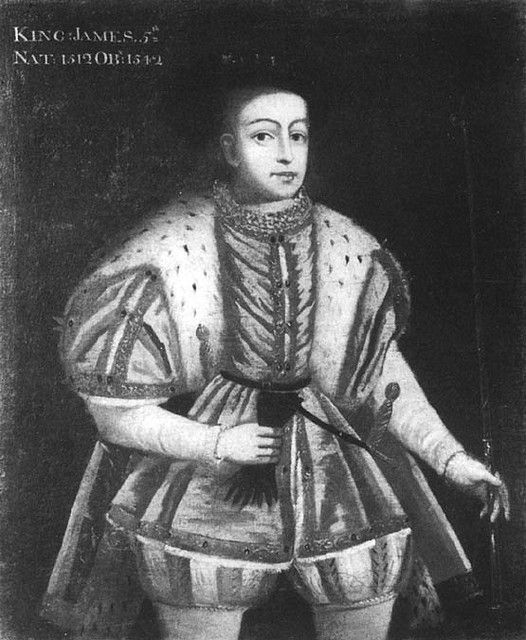
James V as a child
King James V as a boy
Scottish National Portrait Gallery

When it came time for James’ step-father, the Earl of Angus to take his turn, he took James prisoner and ruled in his place. Several attempts were made to free the young king and he finally escaped to resume his power when he was 15 years old. One of his first acts as king was to exile the Douglas family. He even went so far as killing Angus’ sister, Janet Douglas, Lady Glamis, by burning her at the stake for witchcraft.
Due to the Auld Alliance, James procured the hand of Madeleine of Valois, the daughter of French King Francis I. She was frail and sickly from the time she was a child and her father refused at first to allow James to marry her. Finally convincing Francis to allow the marriage, they married in January 1537. However, Madeleine died of consumption seven months later without giving James an heir.
Less than a year later, James married the 21 year old widow, Mary of Guise.

A Wanted Woman

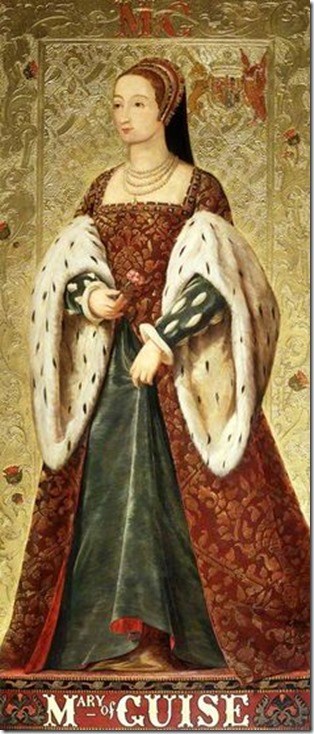
Mary of Guise was born in Lorraine, France in 1515. She was the eldest of twelve children born to Claude of Lorraine, Duke of Guise and Antoinette of Bourbon. When she was 18, a marriage was arranged for her to Louis II d’Orléans, Duke of Longueville. She bore Louis a son, whom they named François, and was pregnant with their second child when her husband died of what is believed to be smallpox. Her second son was named after his father, but only lived a few months after his birth. Marie-de-Guise_thumb


Mary was young, attractive, intelligent, and valuable to the French court. Soon the king of France was looking to put her many assets to good use. It didn’t take long for her to be courted by two kings: James V, the king of Scotland, and Henry VIII, the king of England.
Mary and James had met the previous year when he came to France to meet Madeleine. He thought her attractive and now turned his attentions toward her in an effort to maintain French-Scottish relations. Henry VIII had lost his third wife, Jane Seymour the year before as well. When he got wind of James’ intentions, he too sought to obtain Mary’s hand in marriage to prevent the union. It is said that Mary was concerned for her safety at the hands of the English king, making a comment on her small neck as an excuse not to marry the man, a reference to his beheaded queen, Anne Boleyn.
Eventually, Francis I of France decided that James would be the better match. They were married by proxy in France in May 1538. Due to the death of her first husband, the Duke of Longueville, Mary’s young son would have to be left behind in France as he was now the new Duke of Longueville. She arrived in Scotland a month later and was married to James in St Andrews Cathedral.

james_v_of_scotland_and_mary_of_guise-2

The Good Wife

It didn’t take long for Mary to give James a desired heir. Their first son, James, was born in May 1540 and a second, Robert, joined in April 1541. However, both boys died just days after Robert was baptized. Unfortunately, as with any good queen, the show must go on, and less than a year later Mary was pregnant again.

The Beginning of the End

With the death of James’ mother and the bonds of relationship between nephew and uncle being strained over the burgeoning Protestant reformation, James soon found himself at war with his uncle Henry. Having ignored his uncle’s urging to break away from the Catholic church, he added insult to injury when he refused to meet with Henry. The English king, being the tyrant that he was initiated an attack on Scotland.

Scottish forces suffered a great loss at the Battle of Solway Moss. The king, who did not fight in the battle because he was sick with a fever, sunk further into despair. When the news reached the king that his wife had given birth to a daughter on 8 December, and not the desperately hoped for son, the king is believed to have made the prophetic, yet disheartening statement, “It began with a lass and it shall end with a lass”, making a reference to the beginning and ending of the House of Stuart.
James died six days later, with only one legitimate child left alive to take the throne: Mary.

The Show Still Must Go On

After James’ death, Mary of Guise continued to carry the Catholic torch in Scotland. She spent quite a bit of her time battling the Scottish lords for the regency and trying to avoid Henry’s matrimonial advances toward herself and her young daughter. By this time Henry had worked his way through two more wives and was still interested in adding Mary of Guise to that list. If that didn’t work, he wanted the young queen for his heir, Edward. When it became apparent that he would get neither, he initiated a war with Scotland known as the Rough Wooing. Determined to protect her daughter from an English marriage, she snuck the child away to France when Mary was five years old. Arrangements were made for her to be brought up in the courts of the French king, and eventually marry his son, the Dauphin, Francis.

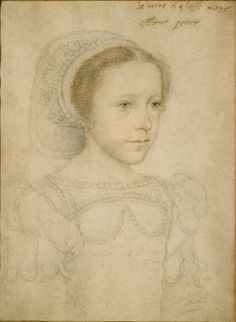
mary queen of scots child
Mary, Queen of Scots as a child ~ by François Clouet

In 1550, Mary of Guise returned to France and reunited with her only daughter whom she hadn’t seen in two years. She travelled extensively throughout France but eventually made her way back to Scotland where she eventually took over regency in 1554. She worked closely with her brothers, the Cardinal of Lorraine and the Duke of Guise and these dealings kept Scotland and France in close diplomatic relationship for as long as she held the regency.

As Protestantism grew in Scotland, Mary’s influence declined. However, she managed to maintain control of the regency until her death due to dropsy in 1560. Her body was eventually snuck to France, and Queen Mary was able to attend her mother’s funeral.


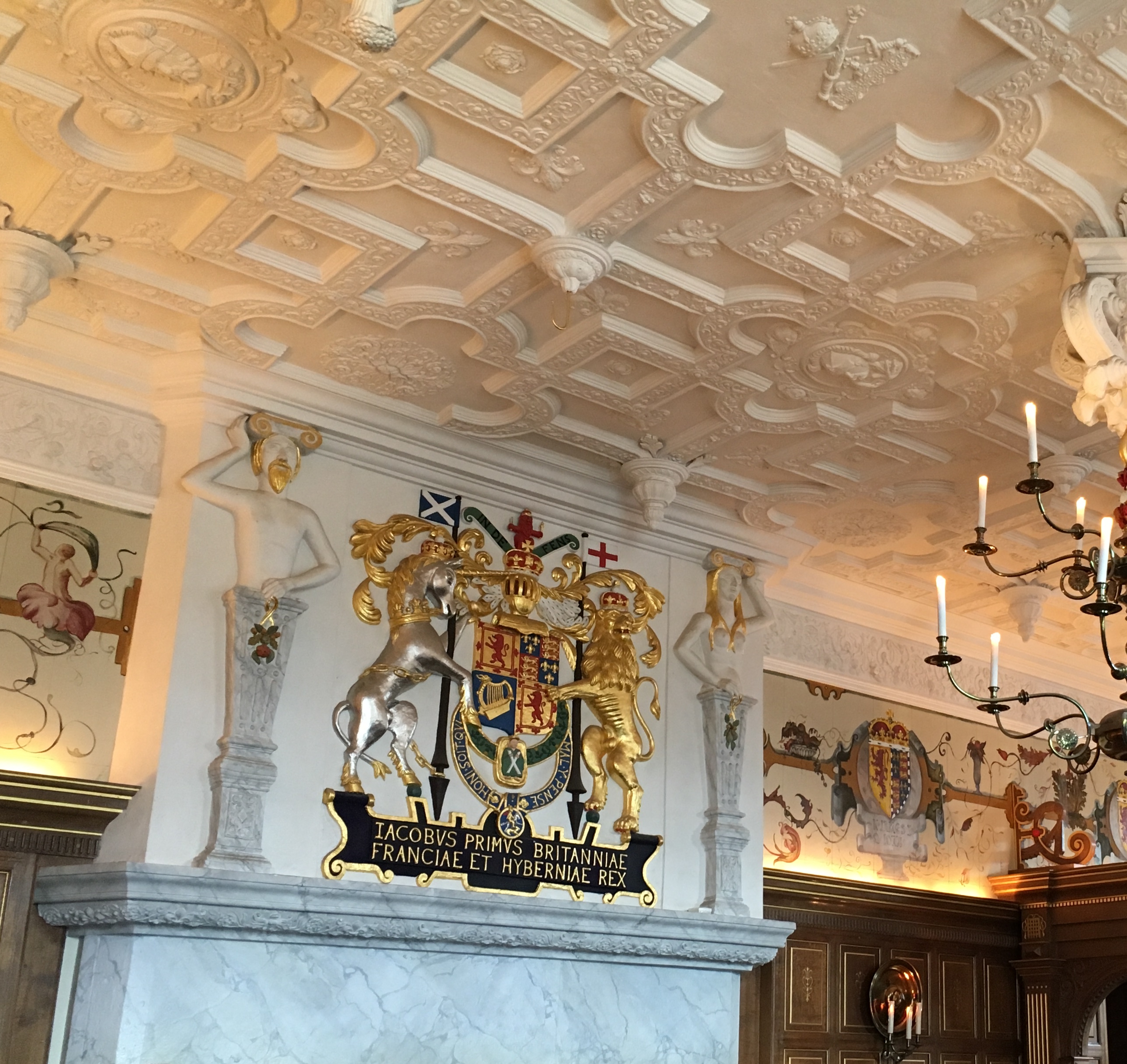
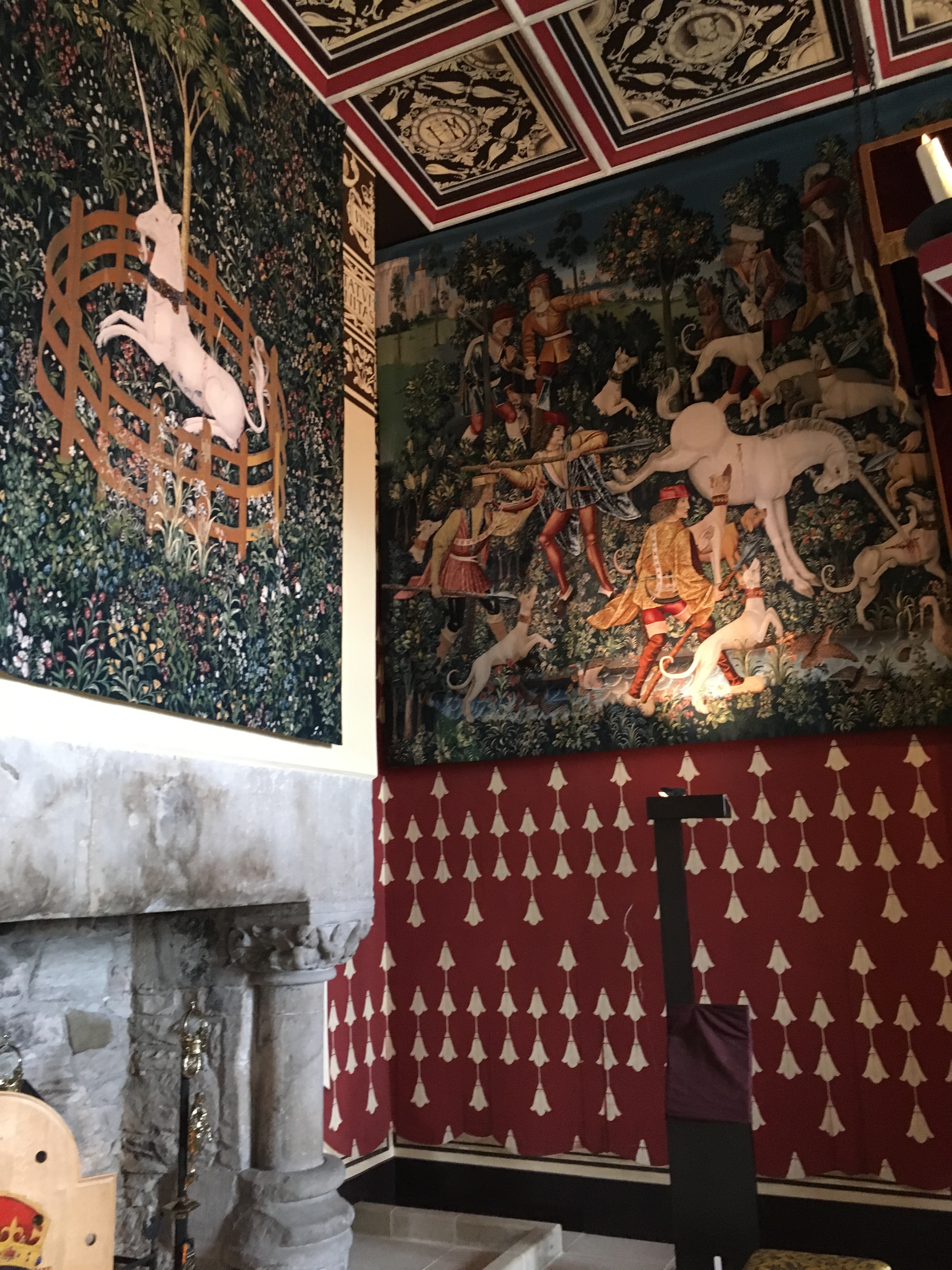
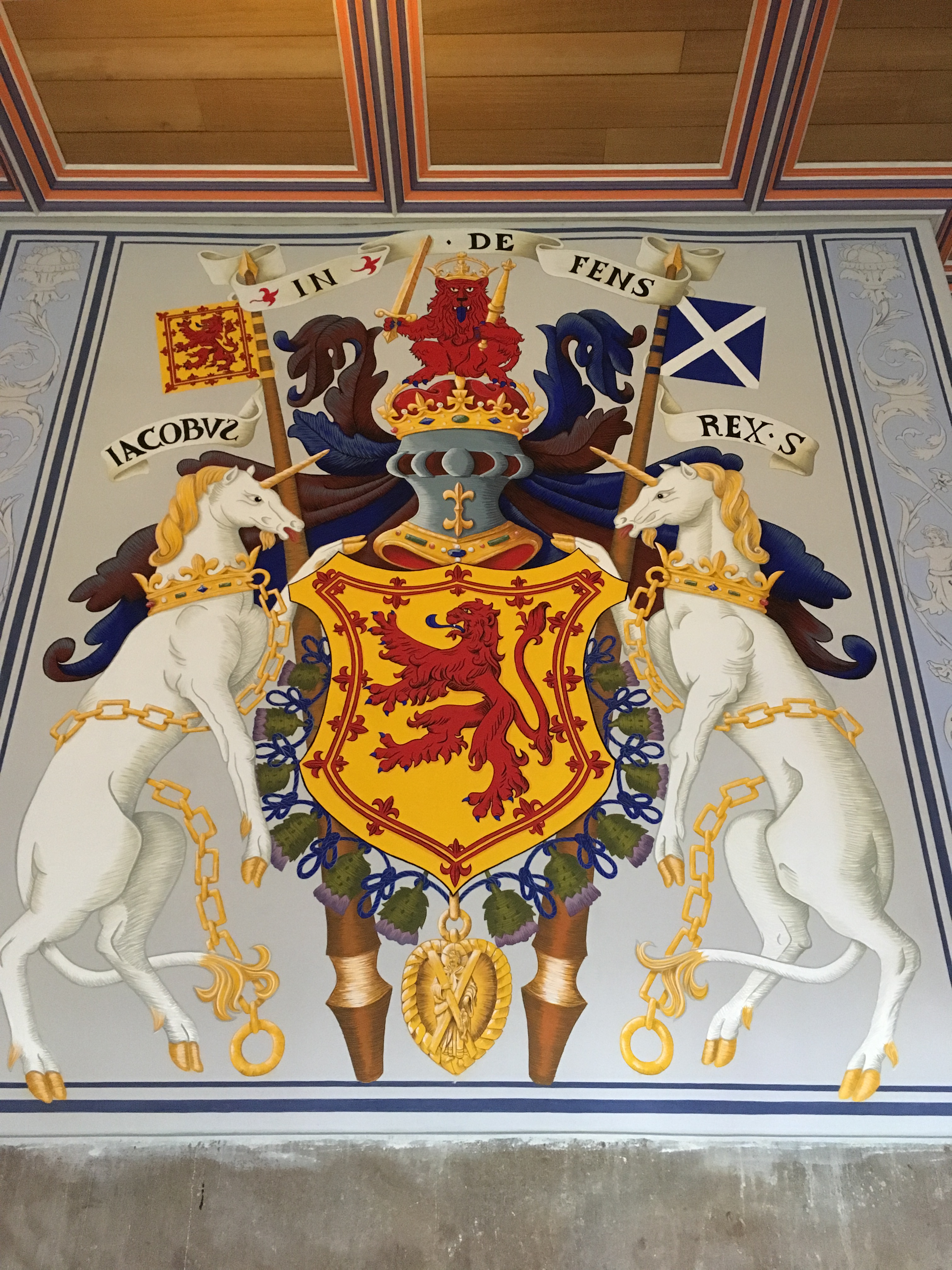
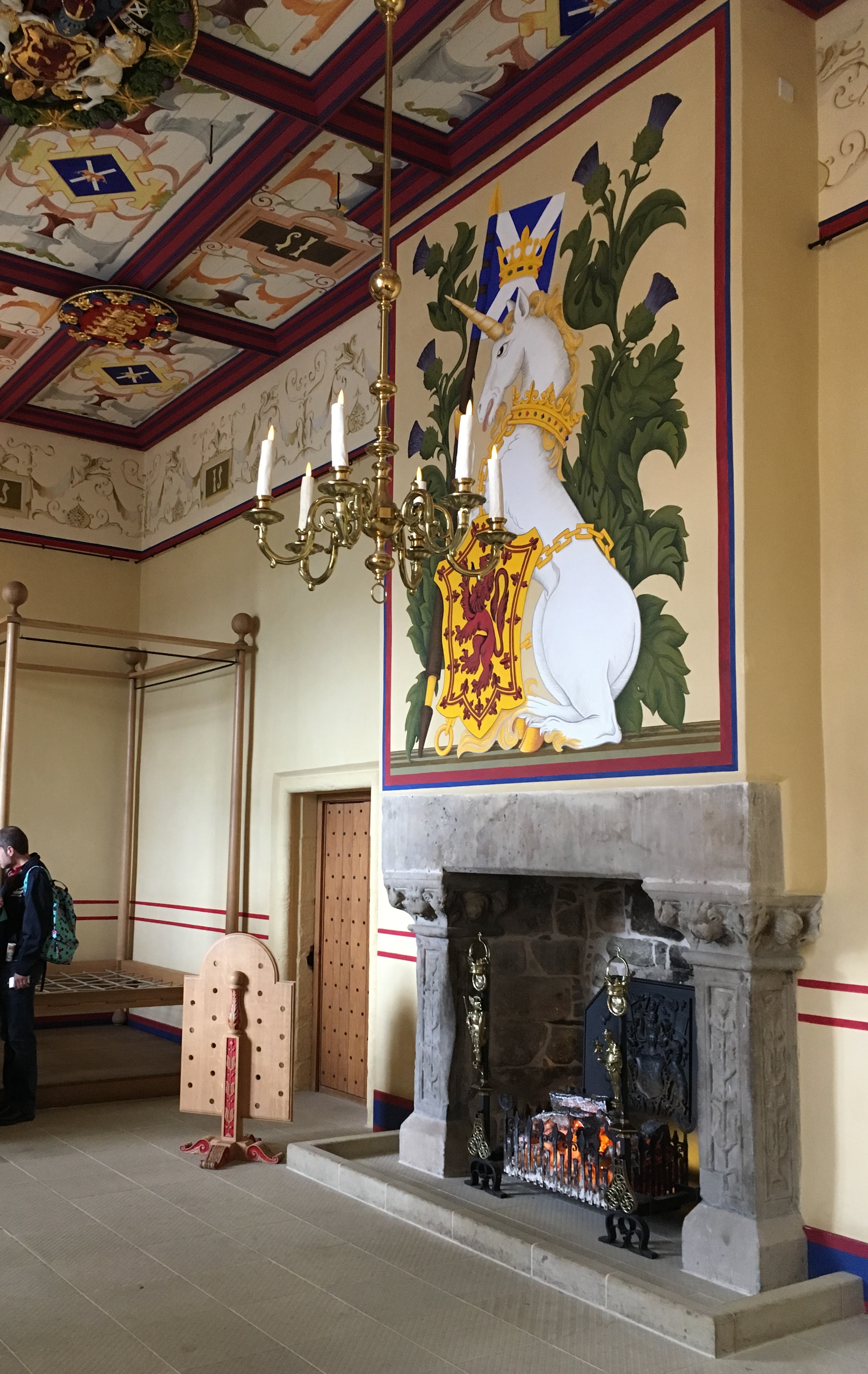
Below are pictures from my time spent at Stirling Castle, one of the principal places of residence for King James V and Mary of Guise. It is located in Stirling, Scotland. These pictures were taken in June 2017.

Portrait of James V and Mary of Guise, anonymous artist, c. 1542, at Falkland Palace

Posted in Principal Players Series

Mary Stuart – The Queen of the Scots

                 *Please note: this post is part of a series. To read the parent post click here*

                                                                ~Antonia Frasure

I heard the name Mary Queen of Scots for the first time when I was about 13 years old. She was the subject of a play being performed by the fictitious Kingsport Ladies College in the movie Anne of Avonlea. I listened as a young girl named Emmaline described the traumatic death of the queen, swooning as she imagined playing the tragic character on the school’s stage.

It wasn’t until many years later, as an adult, that I actually learned who this queen was and why her story was so tragic. I cannot pinpoint for you the moment I first fell in love with her. But I can tell you that once I read her story I was fascinated and since then I have read scores of material about her life, forming my own opinions about her guilt or innocence and speculating on why she made the choices she made.

So, why is this woman so important? She didn’t leave behind the glorious legacy that her cousin Elizabeth I did; strengthening her kingdom or further advancing political, economic or literary benefits. She didn’t write books or share knowledge that furthered her cause or benefitted the church of Europe that was in the massive throes of upheaval in some way. However, as with any life, there were ramifications from her choices. The decisions she made, whether bad or good, set up the opportunity for other events to happen, positioning other players in place and enabling them to bring about changes to their world and giving us the results we have today. I think primarily of her son, James VI & I who was responsible for one English translation of the Bible used for hundreds of years in many Protestant churches and is still used, to some extent, today (King James Version Bible/KJV).

For many Scots in the 16th century, her birth was a disappointment and her death a satisfaction. From her first breath to her last she was scrutinized, reproached, ridiculed and condemned. So why, after almost 433 years since her death, is she fondly remembered, romanticized, loved?

There is so much that can be said about this woman and the things that happened to her before her life was cut short (she was 44 when she was executed). The purpose here is not to cover every plot or conspiracy theory that pertains to Mary Stuart. It’s just a simple overview of her life. Is it biased? Probably. Do I hope you fall in love with her as much as I have? Most definitely!

it cam’ wi’ a lass, and it’ll gang wi’ a lass

Mary was only six days old when her father, King James V died, making her queen of Scotland.  Although there are debates as to whether James actually said these words, legend purports that, upon learning of the birth of his daughter (and knowing already that he was dying) he said, “it cam’ wi’ a lass, and it’ll gang wi’ a lass” (it came with a girl and it will end with a girl). The House of Stewart (Scottish spelling) began when a Stewart married Marjorie, the daughter of Robert the Bruce. James meant that their line began with a marriage to the daughter of a king and it would die with the daughter of a king. In some respects, he was correct; the House of Stewart did indeed end with a lass, but it wasn’t Mary. Instead, it wouldn’t be until almost 200 years later when Mary’s great, great grand-daughter, Queen Anne died childless, thus ending the reign of the Stewart line.


New Beginnings in France

When Mary was five years old her mother, Mary of Guise, sent her to France in order to escape the reach of Henry VIII. The English king had been trying to obtain the little queen as a wife for his son, Edward (VI), resulting in a war between England and Scotland called The Rough Wooing. Mary of Guise, acting as regent for her young daughter, was a Catholic and sought a union between Catholic France and Scotland, which was already in turmoil over the Scottish reformation.

Mary was eventually betrothed to the young Dauphin, Francis, who was a year younger than her. They grew up together as the best of friends and were married  in April of 1558. The ceremony took place in the Cathedral of Notre Dame in Paris. John Guy described the beautiful young bride in his book Queen of Scots, The True Life of Mary Stuart.

“The crowd only had eyes for Mary. They virtually ignored Francis, whose short, weedy build must have presented a strange contrast to her height and womanly beauty. They craned their necks to catch sight of her, cheering and waving their hats in the air. She looked radiant in her shimmering white dress, itself a daring and unconventional choice because white was the traditional color of mourning for royalty in France.”

When Francis’ father, King Henry II died from a jousting accident a year later, Francis ascended the throne, making Mary a queen for the second time. She was 16 years old.

Returning to Scotland

Tragically, Francis died one month shy of his 17th birthday from complications of an ear infection. With Francis’ younger brother, Charles IX taking the throne, there was no longer a need for Mary to stay in France. Her mother, who had been ruling in her stead, had died six months before her husband. It was time for her to return to her homeland, which she had not seen since she was five years old.

Mary stepped into a boiling pot of parritch so to speak when she reached Scotland. The country was in the middle of a Protestant reformation, making it difficult for the young Catholic queen to come back peaceably. However, although her Catholic supporters hoped that her return would be just the card they needed to win the game, Mary had no intentions of creating a blood bath as her cousin, Mary Tudor, had done in England. Mary Stuart proved to be a tolerant sovereign, allowing her subjects to worship as their consciences saw fit.

Time to Find a Husband

In the first couple of years after her return to Scotland, Mary wrote faithfully to her cousin, Queen Elizabeth. She endeavored to keep up a good relationship with the English queen who was her elder by 9 years. She sought to please Elizabeth in all matters in hopes that Elizabeth would eventually name her as her successor, should the queen decide not to marry and therefore produce no heir.

Mary had a legitimate claim to the English throne. She was the granddaughter of Margaret Tudor, Henry VIII’s eldest sister. Since Elizabeth was the child of Henry’s second wife, whom he married after divorcing his first, Catholic subjects did not view her as a legitimate child, let alone heir to the throne. In their eyes, Catherine of Aragon, Henry’s first wife was his one and only true wife. When Henry’s only son, Edward VI died, and then his daughter by Catherine, Mary Tudor died, that left England looking for a rightful heir. As granddaughter of the next of kin to Henry, Mary was a logical choice. However, Henry had tried to exclude Scotland from any succession with the Third Act of Succession in 1544, which would have technically excluded Mary Stuart as well.

Although it was rumored that Elizabeth preferred Mary over any of her other possible choices, she was hesitant to make it official. Mary’s Catholic views probably paid a large roll in Elizabeth’s hesitancy.

For several years Elizabeth played a game of Simon Says with Mary. She persuaded her to think that, if she were to choose a husband to her liking, Elizabeth may be inclined to name Mary as her successor. Mary was not to entertain ideas of marriage to any man that Elizabeth did not first approve of. She even went so far as to offer her own beloved Robert Dudley, who was rumored to be Elizabeth’s lover, as a suitor for Mary. Mary bulked at this suggestion at first, but when she finally agreed to meet him, Elizabeth had second thoughts and eventually withdrew her support of her own suggestion!

Fed up and ready to marry, Mary decided to take matters into her own hands.

Husband #2

Mary was courted by many kings and noblemen. However, Henry Stewart, more famously known as Lord Darnley, was her final choice. He was Mary’s first cousin, having shared a grandmother in Margaret Tudor.

Elizabeth was not happy about Mary’s choice, for Henry was too close in the English line of succession for her comfort. But she unwittingly set them up for courtship, not realizing it until it was too late. Henry was an English subject, so when Elizabeth had made the mistake of allowing him to go to Scotland (more on that in a later post) there was no turning back.

It was a whirlwind romance, so to speak. He came to Edinburgh in February of 1565. By April there was a flourishing romance blooming and by July they were wed.

Henry was the perfect gentleman when he first came to Scotland and did a grand job of making allies and endearing himself to the Scottish court. He was reported as being very handsome and full of charm. But just as quickly as their courtship transpired, so did the unraveling of the Scottish lords’ good opinion of him. He soon proved himself to be as spoiled as a petulant child. He was boorish and rude and pestered Mary about making him her king consort, which she eventually did. However, what he really wanted was the crown matrimonial. This would give him precedence over Mary and insure that he gained the crown (before any children) should something happen to Mary. Mary refused to give him the upper hand and it didn’t take long for the marriage to turn sour.

Within a year, he had made so many enemies that many were plotting how to get rid of him. By this time Mary had borne Darnley a son (to later become James VI & I). Their marriage was a tumultuous one in which Mary had been attempting a reconciliation. But in the early morning hours of February 10, 1567 the house where Darnley had been residing, Kirk o’ Field, was blown up. His body was later found half-clothed in the garden and there were signs that he had been strangled. There were many who had reason to want him dead, and many who had an opportunity to make it happen. Even Mary was accused at one point of being a part of the plot. No one wanted to believe that the lovely queen could be a part of such a horrific act, but her subsequent actions, so soon after the death of her husband, have left historians scratching their heads for centuries since.

The Last Straw

Several people were implicated in the murder of Darnley, but records later show that there was one particular man that had his hand in the carrying out of the act. James Hepburn, the Earl of Bothwell, was the Captain of the Queen’s Guard. Not long after the explosion he was arrested for part and plot in the king’s murder, but Mary soon acquitted him. This was perhaps another wrong step in what seems to be many in the days and months leading up to the loss of her kingdom.

There seems to be more than a loyalty to country that drove Bothwell to rid Scotland of such a cankerous sore as Darnley. Bothwell had intensions toward Mary and soon began to put plans in place to make her his wife.

Bothwell had drawn up an agreement, in which he had a host of the leading nobles and bishops of Scotland sign. The document, now known as the Ainsley Tavern Bond, indicated that these Scottish lords recognized Bothwell’s innocence in the murder of the king and supported his intentions to marry the queen. Furthermore, it pledged their support in seeing such a plan come to fruition, seeing he was a Scottish born suitor.

A week later, while on her way back from visiting her son who was hidden away at Stirling Castle, Mary was abducted by Bothwell, who had convinced her that danger awaited her in Edinburgh. He whisked her away to his castle at Dunbar where he proceeded to convince her that it was the Scottish nobles’ wish for them to be married.

There were several roadblocks to this scheme. For one, Bothwell was still married; his wife having already been offered a divorce. Another problem for Mary was that this was the man that many still believed to be responsible for her second husband’s murder, a husband who had only been dead for two months. Mary refused his offers at first but found herself inclined to finally accept with the help of Bothwell’s rough persuasions. It has been said that the earl forced himself on Mary and she eventually felt she had no other choice

The Downfall of a Queen

After Mary acquiesced to Bothwell’s scheme, they were married within a month. But it wasn’t long before those who opposed Bothwell as her husband rose up against them. They were out for blood and wanted the man responsible for the king’s murder dead. Mary and Bothwell were confronted on Carberry Hill where a day’s worth of negotiations played out under the hot June sun. The Scottish lords gave Mary two choices to avoid a battle; either she release herself from Bothwell forever, or Bothwell should come and fight one on one in hand to hand combat.

Mary was angry and shocked. According to John Guy her answer to the lords was thus:

“It looks very ill of them, to go against their own signed bond, after they themselves married me to him, having already acquitted him of the deed which they would now accuse him.”

Much deliberation commenced with Bothwell gladly taking on the challenge. Yet Mary wanted the lords to see their folly and surrender to her with a promise of pardon. It was finally decided that Bothwell would fight in single combat; but when a worthy opponent had finally been accepted, Mary put a stop to it. She knew that either way the fight ended she would not come out ahead. John Guy further explains:

“If Bothwell lost, she would be the lords’ prisoner and would have lost her protector. If he won, she would still lose, because she had come to know Morton (Bothwell’s partner in the murder of Darnley) for what he really was. He would never accept the result. Either the rebel lords would order their forces to charge or else they would send other champions to repeat the challenge until Bothwell collapsed from exhaustion or died of his wounds.”

Eventually, Mary negotiated for the lords to allow Bothwell a release and she would go with them peaceably. Bothwell eventually escaped to Norway, where he was imprisoned and eventually died. Mary was put under arrest and forced to abdicate her throne to her 10 month old son, James. It may have been the stress of all of these things coming against her that caused her to miscarry a set of twins during this time as well. 

The Beginning of the End

Mary eventually escaped her Scottish captors and fled to England for protection. Although Elizabeth had at first been sympathetic to Mary’s plight (she was appalled that the Scottish lords had imprisoned their own anointed queen), she was apprehensive as well. There was too much scandal surrounding Mary.

Mary was put under house arrest upon entering England and remained there for the next 19 years. Although she lived in relative comfort for the most part, she was still not a free woman. Her health eventually began to decline and she even indicated that she had no wish to take upon herself once more the responsibilities of the throne. However, she had many supporters in Scotland and England, and never stopped seeking an escape. It was no secret that Mary wished to be free from her imprisonment. There were several plots hatched to procure her escape, and some included plans to take the throne of England in the process. Many historians believe these were schemes developed by outside forces and Mary had no true intentions of overthrowing Elizabeth’s throne.

However, in August of 1586 another plot was discovered that would eventually bring about Mary’s demise. (You can read about the Babington Plot and Mary’s arrest in England here) Mary was tried and convicted of treason even though she was not an English subject and by law could not be tried for treason of an English sovereign. She was sentenced to death in October, but Elizabeth did not sign the death warrant until February of the following year.

The warrant, having been signed on the first of February, was carried out on February 8, without Elizabeth’s knowledge. When she discovered her Privy Council had acted without her authority Elizabeth was angry and imprisoned one of her councilors as punishment. This was a good excuse to expunge any guilt on the English queen’s part in the murder of another sovereign.

Mary was led to the execution block in the early morning hours. Under her outer garments she wore a crimson petticoat, indicating her belief that she was being executed as a martyr. When she finally laid her head upon the block, it took the executioner three tries before completely severing her head.

Her wish had been to be buried in France, but Elizabeth denied that request. Instead, her remains were initially buried at Peterborough Cathedral. She was eventually moved to Westminster Abbey at the command of her son, James VI & I, who succeeded Elizabeth to the English throne in 1603.mary-2-1